 By Adrien Blanc
Daily Routines That Actually Work: A Practical Guide

A daily routine is a repeatable sequence of habits anchored to specific times of day. The right routine doesn't require superhuman discipline — it requires structure that removes decisions and makes your best behaviors automatic. Research backs this up: the average worker is only productive for about 2 hours and 53 minutes out of an 8-hour workday. The difference between high performers and everyone else isn't talent or willpower — it's that they've designed their days so the important things happen by default.
This guide gives you practical frameworks for building morning, evening, and weekend routines that fit your real life. No 4 AM alarms required. No 27-step sequences. Just evidence-based structures you can adapt, track, and refine over time.
2h 53m
average productive time in an 8-hour workday
Why Most Daily Routines Fail
Most routines fail because they're designed for someone else's life. You copy a CEO's morning ritual or a fitness influencer's schedule, and within a week, it collapses. There are three core reasons this happens.
1. Too Many Changes at Once
Adding 8 new habits simultaneously overwhelms your willpower. Research from Roy Baumeister shows that self-control functions like a muscle — it fatigues with use. Every decision you make throughout the day drains the same limited pool. When your morning routine requires a dozen new choices, you burn through willpower before breakfast.
2. Relying on Motivation Instead of Structure
Motivation fluctuates. Structure doesn't. As organizational psychologist Benjamin Hardy explains, decision fatigue is the real enemy: "The reason people's willpower becomes exhausted is that they are constantly weighing in their mind what they want to do." A working routine eliminates those decisions by making the next action obvious.
3. No Recovery Built In
82% of employees are at risk of burnout in 2025, and one major contributor is the lack of deliberate rest. A routine that's all output and no recovery isn't sustainable. Exhaustion responds to rest, but burnout persists even after time off. Your daily routine needs both productive blocks and genuine downtime.
The Building Blocks of an Effective Daily Routine
Every effective daily routine shares four elements: a consistent anchor, a defined sequence, minimal decisions, and built-in flexibility.
Anchors: The Fixed Points of Your Day
Anchors are non-negotiable activities that happen at roughly the same time every day — waking up, eating meals, starting work, going to bed. Your routine is built around these anchors, not in spite of them. Research on sleep consistency involving 92,340 participants across 14 countries found that regular sleep and wake times were strongly associated with better health outcomes. Consistency itself is a health behavior.
Sequences: Chain Actions Together
Habit stacking — attaching a new behavior to an existing one — is one of the most reliable ways to build routines. "After I pour my coffee, I journal for 5 minutes." "After I close my laptop, I go for a 10-minute walk." Each habit becomes the cue for the next one, creating a chain that runs with minimal thought.
Minimal Decisions
The fewer choices your routine requires, the more likely you'll follow it. This is why people like Steve Jobs wore the same outfit daily — not because the clothing mattered, but because eliminating trivial decisions preserves cognitive resources for important ones.
Built-In Flexibility
Rigid routines break under pressure. The best routines have a fixed core (3-5 non-negotiable habits) and a flexible periphery (nice-to-haves that you skip when life gets hectic). A perfect routine you can't sustain is worse than an imperfect one you follow every day.
Build your daily routine with Habit Streak
Download Free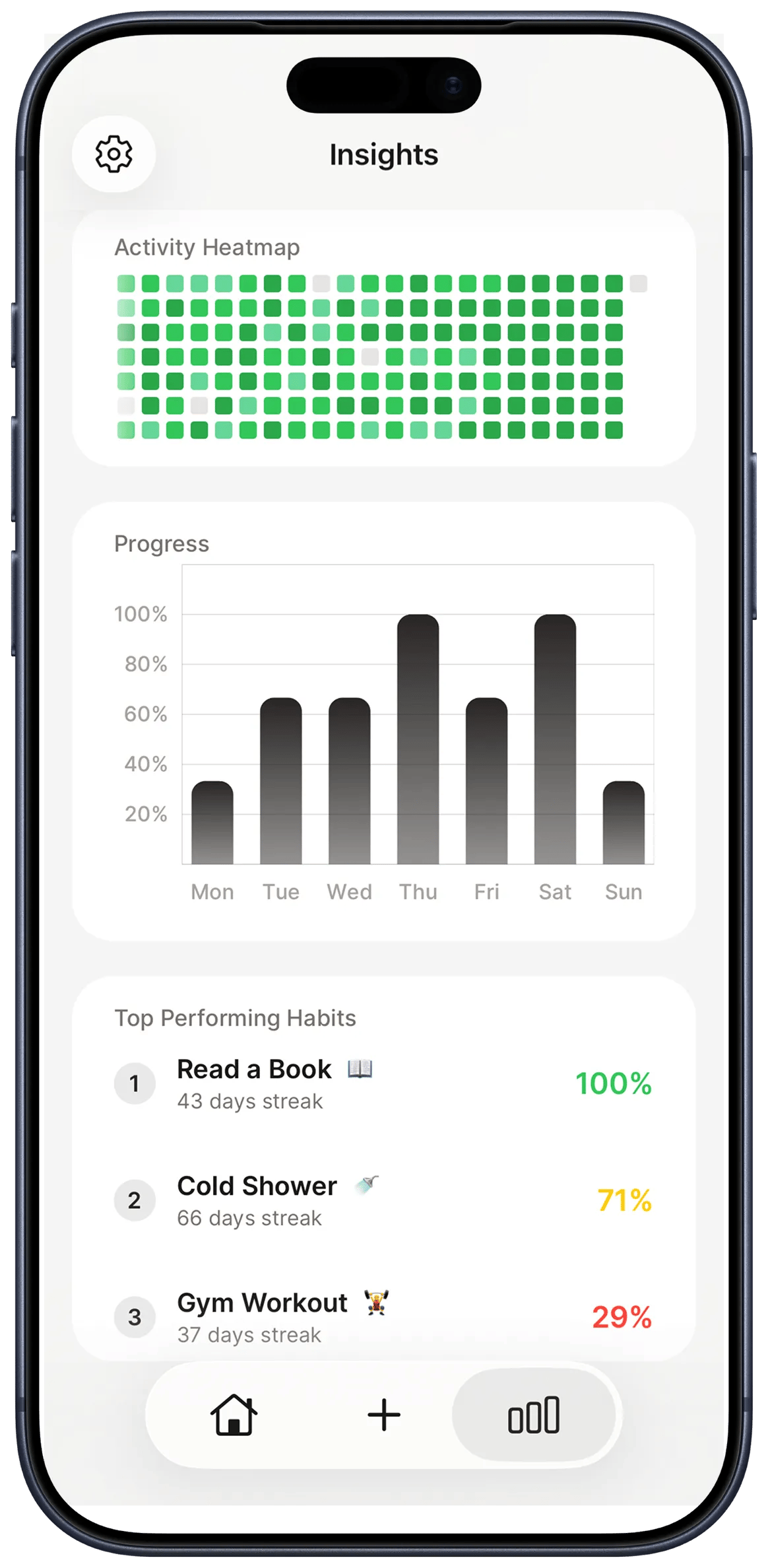
Morning Routine Framework
Your morning sets the trajectory for the rest of your day. 49% of people say their morning plays a major role in dictating how the rest of their day goes — and among millennials, that number rises to 57%. More importantly, research at the University of Pennsylvania found that employees who start their morning in a good mood rate experiences more positively throughout the entire day.
Here's a framework you can customize, not a rigid schedule to copy:
Phase 1: Wake-Up (5-15 minutes)
The goal is to move from sleep inertia to alert wakefulness. Studies show that 82.5% of people experience sleep inertia — that groggy, half-asleep state — for 15 to 30 minutes after waking.
- Hydrate immediately. Losing just 1-2% of body weight in water hurts alertness, concentration, and memory. A glass of water reverses overnight dehydration.
- Get light exposure. Natural light signals your circadian system to suppress melatonin and increase cortisol (the healthy wake-up kind).
- Avoid your phone. 49% of people check their phones immediately upon waking, and those who do are more likely to report being unproductive (53%). Your first input shapes your first mindset.
Phase 2: Invest in Yourself (15-45 minutes)
Before the world gets a vote on your day, spend time on something that matters to you personally.
- Move your body. It doesn't need to be a full workout. A study at Appalachian State University found that people who exercised at 7 AM slept faster, deeper, and longer than those who exercised later. Even 10 minutes of stretching counts.
- Practice a focus habit. Meditation, journaling, reading — pick one. Research shows morning meditation enhances focus by 14% and reduces stress levels. Tim Ferriss found that roughly 80% of the high performers he interviewed practiced daily meditation.
- Plan your day. Spend 2-3 minutes identifying your top priority. Benjamin Hardy recommends the "90-90-1" rule: spend the first 90 minutes of your workday on your number one priority.
Phase 3: Transition to Work (10-15 minutes)
- Eat a nutritious breakfast. Workers who ate five fruit and vegetable portions at least four days per week were 25% more productive than those who didn't.
- Review your calendar briefly.
- Start your most important task first — not email.
For a deeper look at whether early rising is worth the trade-offs, see our article on whether a 5 AM morning routine is worth it.
Evening Routine Framework
A good evening routine is less about productivity and more about setting tomorrow up for success. 76% of adults who follow a bedtime routine report high sleep quality, according to a Sleepopolis survey. And 68% of people credit having a good day to getting a good night of sleep. Your evening routine is your morning routine's foundation.
76%
of adults with a bedtime routine report high sleep quality
Phase 1: Shutdown Ritual (15-20 minutes)
This creates a clear boundary between work and rest.
- Write tomorrow's plan. Harvard psychologist Ellen Langer calls this a "cognitive commitment." When your brain knows what's happening tomorrow, it stops ruminating about unfinished tasks. This is what organizational psychologists call the Zeigarnik effect — unfinished tasks occupy mental bandwidth until you either complete them or make a concrete plan.
- Process your inbox one last time. Respond to anything urgent, defer the rest. Then close it.
- Tidy your workspace. A clean environment is a cue that work is done.
Phase 2: Wind Down (30-60 minutes)
- Dim the lights and reduce screen exposure. Electronic devices emit blue light that suppresses melatonin production, tricking your brain into staying alert. If you must use screens, enable night mode.
- Read. Nearly half of bedtime routine practitioners read before bed for an average of 43 minutes. Book readers logged an hour and a half more sleep per week than non-readers.
- Take a warm bath or shower. The Sleep Foundation notes that a warm bath before bed triggers a temperature drop that mimics the body's natural sleep-onset signal.
Phase 3: Sleep Preparation (5-10 minutes)
- Go to bed at the same time. The systematic review of 92,340 participants consistently found that sleep regularity matters more than sleep duration.
- Keep your room cool, dark, and quiet. These are the basics of sleep hygiene, and they work.
- Even a 10-minute routine helps. Research from the American Academy of Sleep Medicine shows that even a short, consistent pre-sleep routine helps you fall asleep faster and stay asleep longer.
For a complete step-by-step evening routine, see our guide on evening routines for better sleep.
Weekend Routines: Balancing Rest and Productivity
Weekends aren't for catching up on everything you missed during the week — they're for recovery. Burnout research is clear: 76% of employees experience burnout at least occasionally, and weekend rest alone is often insufficient if your weekdays lack daily recovery periods. But weekends still play a critical role in maintaining a sustainable routine.
The 3-Block Weekend Framework
Divide each weekend day into three blocks: morning, afternoon, and evening. Assign each block a general purpose:
- One block for maintenance. Errands, meal prep, cleaning — the life admin that keeps your week running smoothly.
- One block for investment. A hobby, a side project, time with friends, learning something new. This is the "third place" activity that isn't work and isn't obligation.
- One block for pure rest. No plans, no obligations, no screens if possible. Nap, sit in the park, do nothing productive. This is non-negotiable.
Protect Your Recovery
Burnout prevention requires protecting 2-5 hours daily for genuinely restorative activities — not just on weekends but every day. On weekends, this means resisting the urge to pack every hour with "productive" activities. Unstructured downtime isn't laziness. It's maintenance.
Keep Sleep Consistent
One of the worst things you can do for your routine is to shift your sleep schedule by 2-3 hours on weekends. This creates "social jet lag" — a mismatch between your biological clock and your social clock. The same research on sleep timing that found regularity matters also found that greater sleep variability was associated with worse health outcomes. Try to keep your wake-up time within 30-60 minutes of your weekday time.
How to Adapt Your Routine to Your Life Stage
No single daily routine works for everyone. The best routine for a college student looks nothing like the best routine for a parent of young children or a remote worker. Here's how to think about adaptation.
For Students
Classes create natural anchors but at irregular times. The key is building study habits around fixed points rather than floating them around the schedule. See our complete guide on habits for students for strategies tailored to academic life.
For Remote Workers
Without a commute, the boundary between work and life dissolves. Employees working from home two days a week were just as productive as office staff and 33% less likely to quit — but only when they maintained clear boundaries. Remote workers need a more deliberate transition routine between "home mode" and "work mode." For specific strategies, read our guide to habits for remote workers.
For Parents
Unpredictability is the norm. Rather than a minute-by-minute schedule, focus on protecting two or three anchor habits — a morning focus habit, an evening shutdown, and one self-care activity. The rest flexes around family needs.
For Night Owls
Chronotype matters. Research consistently shows that forcing an early-bird routine on a night owl produces worse outcomes than working with your natural rhythm. If you're naturally alert at 10 PM, structure your deep work there and protect your mornings for lighter tasks.
Building Your Custom Daily Routine Step by Step
Don't design the perfect routine. Design the minimum viable routine, and iterate. Here's a practical process.
Step 1: Audit Your Current Day
Before building anything new, track what you actually do for 3-5 days. When do you wake? When do you eat? When is your energy highest? Your most productive work block? You can use Habit Streak or a simple notes app to log time blocks throughout the day.
Step 2: Identify Your Anchors
Pick 3-4 fixed points that won't move: wake time, work start, dinner, bedtime. Everything else is built around these.
Step 3: Add Your Core 3
Choose exactly three habits to add — one for each part of the day:
- Morning: One habit that invests in yourself (exercise, meditation, reading)
- Workday: One habit that protects your focus (deep work block, phone-free hour)
- Evening: One habit that prepares you for tomorrow (planning, wind-down, journaling)
Three habits is enough. Research on how many habits to track consistently points to fewer being better. The Tiny Habits method developed by Stanford's BJ Fogg recommends making each new habit so small it feels trivial — because the point is consistency, not intensity.
Step 4: Track and Measure
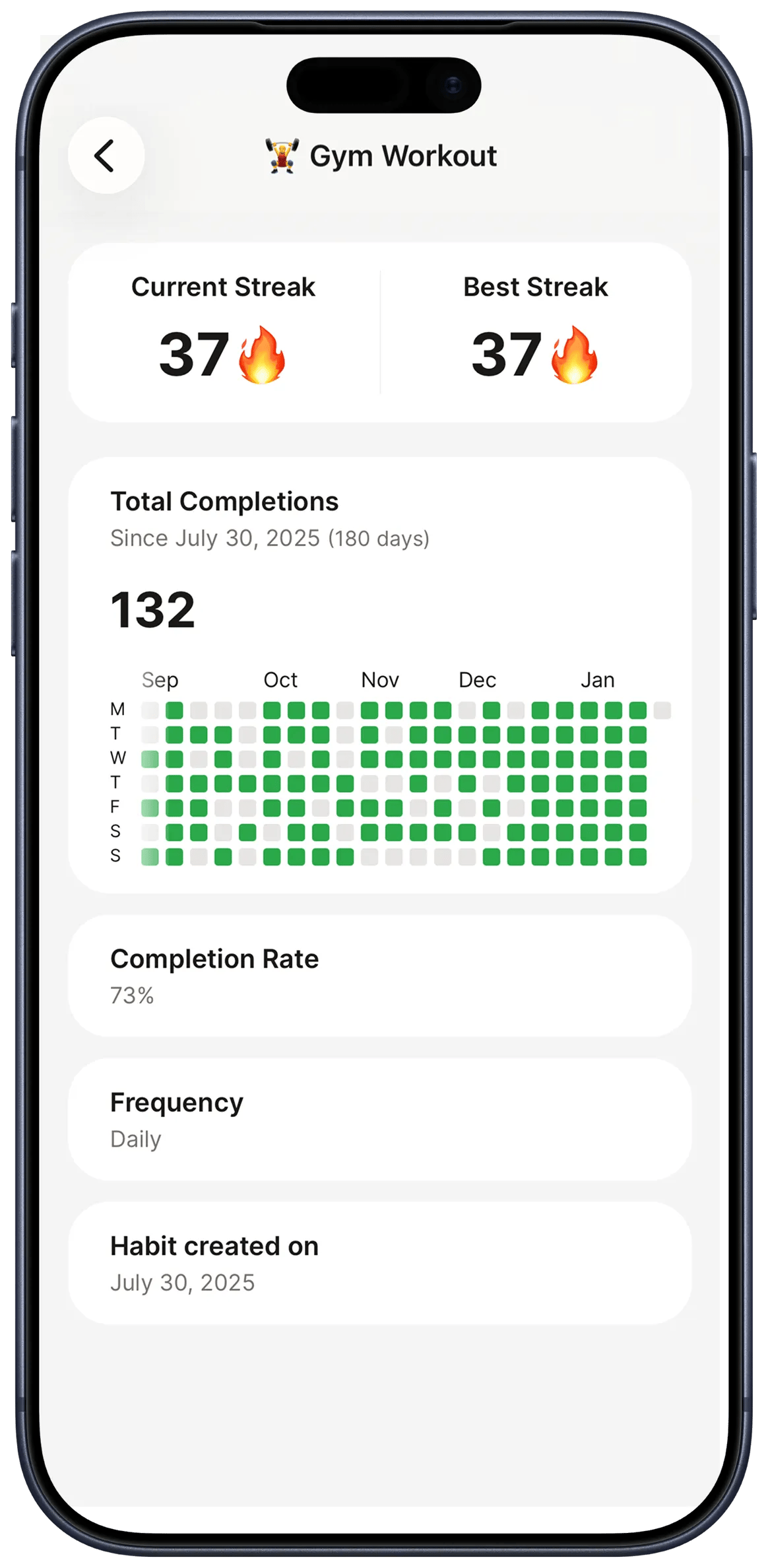
Use a habit tracking system to record your daily completion. The act of tracking itself is a behavior change technique: a meta-analysis of 138 studies with nearly 20,000 participants found that progress monitoring significantly increased goal attainment. Visual streaks create momentum — which is why counting days works.
Step 5: Review Weekly and Adjust
Every week, look at your data:
- Above 80% completion? The habit is working. Consider leveling it up (longer duration, higher intensity) or adding a fourth habit.
- Between 50-80%? The habit is struggling. Make it smaller or change the cue.
- Below 50%? The habit doesn't fit. Replace it or redesign the trigger.
The top 10% of productive workers work fewer than 8 hours per day and take approximately 20-minute breaks for every hour of work. Effective routines aren't about cramming more in — they're about structuring your energy.
Track your daily routine with Habit Streak
Download FreeStep 6: Evolve Over Time
Your routine should change as your life changes. What worked in January might not work in June. The habits that needed tracking six months ago might now be automatic. Retire automatic habits from your tracker and add new ones. A routine is a living system, not a fixed contract.
Daily Routine Examples
Here are two sample routines to illustrate the frameworks above. Adapt them — don't copy them.
Example 1: The Early Riser (6:30 AM wake-up)
| Time | Activity | Purpose |
|---|---|---|
| 6:30 AM | Wake, hydrate, sunlight | Wake-up phase |
| 6:45 AM | 20 min walk or stretch | Movement |
| 7:15 AM | Journal + plan the day | Focus habit |
| 7:30 AM | Breakfast | Fuel |
| 8:00 AM | Deep work block (90 min) | Priority work |
| 9:30 AM | Break, then email/meetings | Transition |
| 12:00 PM | Lunch + short walk | Recovery |
| 1:00 PM | Collaborative work | Afternoon block |
| 5:30 PM | Shutdown ritual | Work-life boundary |
| 6:00 PM | Dinner, family, hobbies | Personal time |
| 9:00 PM | Wind down, read | Evening routine |
| 10:00 PM | Sleep | Recovery |
Example 2: The Night Owl (8:30 AM wake-up)
| Time | Activity | Purpose |
|---|---|---|
| 8:30 AM | Wake, hydrate, light breakfast | Wake-up phase |
| 9:00 AM | Email triage, admin | Low-energy tasks |
| 10:00 AM | Meetings/collaboration | Social block |
| 12:30 PM | Lunch + walk | Recovery |
| 1:30 PM | Deep work block (90 min) | Priority work |
| 3:00 PM | Break, then second work block | Focus |
| 6:00 PM | Shutdown ritual, plan tomorrow | Boundary |
| 6:30 PM | Exercise | Movement |
| 7:30 PM | Dinner, hobbies | Personal time |
| 9:30 PM | Creative work or reading | Peak alertness |
| 11:00 PM | Wind down, no screens | Evening routine |
| 11:30 PM | Sleep | Recovery |
The key difference: both routines have the same building blocks (movement, deep work, planning, wind-down), but they're arranged around different natural energy patterns.
Frequently Asked Questions
What is the best daily routine for productivity?▼
The best daily routine for productivity includes three elements: a morning investment habit (exercise, meditation, or planning), a protected deep work block of 60-90 minutes, and an evening shutdown ritual. Research shows the top 10% of productive workers focus in concentrated bursts with regular breaks, rather than working long uninterrupted hours.
How long does it take to build a daily routine?▼
Research from University College London found that forming a single habit takes an average of 66 days. A full daily routine with multiple habits may take 2-3 months to feel automatic. Start with just 3 core habits and add more only once those feel effortless.
What should a morning routine include?▼
An effective morning routine includes hydration, light exposure, brief movement or exercise, and one focus habit like journaling or meditation. Avoid checking your phone immediately — studies show that people who check their phones first thing are more likely to report feeling unproductive throughout the day.
How do I stick to a daily routine when life gets busy?▼
Focus on your core 3 non-negotiable habits and let everything else flex. Track your habits with an app to maintain accountability, and follow the 'never miss twice' rule: if you skip a day, get back on track the next day. A routine that adapts to disruption is more sustainable than a rigid one that breaks under pressure.
Do I need to wake up at 5 AM to be productive?▼
No. Research supports consistency over early rising. A routine that starts at 7:30 AM every day is more effective than a 5 AM routine you can only maintain occasionally. Your chronotype — whether you are naturally a morning person or a night owl — matters more than the specific hour you wake up.
- 1.10 productivity research studies from 2025desktime.com
- 2.Willpower: How to Overcome Decision Fatigue and Commit To Your Habitssamuelthomasdavies.com
- 3.explainsinc.com
- 4.25 Burnout Statistics for 2025growthalista.com
- 5.Sleep timing, sleep consistency, and health in adults: a systematic reviewpubmed.ncbi.nlm.nih.gov
- 6.preserves cognitive resourceslifehack.org
- 7.Morning routines strongly impact how the rest of the day goestalkerresearch.com
- 8.Studies show that 82.5% of peopledrpaulmccarthy.com
- 9.Building Your Perfect Morning Routine: a Science-Based Guideconfidecoaching.com
- 10.49% of people check their phones immediately upon wakingdreammakerr.com
- 11.23 Research Backed Tips to Supercharge Your Morning Routineearlytorise.com
- 12.The Science-Backed Morning Routine That Changed My Life in 30 Daysmusclemx.com
- 13.Survey Sheds Light On Popular Bedtime Routines and Nightly Rituals of Adultssleepopolis.com
- 14.Zeigarnik effecten.wikipedia.org
- 15.suppresses melatonin productionsleepfoundation.org
- 16.Sleep Hygiene Tips for a Better Night’s Resthealth.clevelandclinic.org
- 17.protecting 2-5 hours daily for genuinely restorative activitiesreclaim.ai
- 18.Does monitoring goal progress promote goal attainment? A meta-analysis of the experimental evidencepubmed.ncbi.nlm.nih.gov