 By Adrien Blanc
The Complete Guide to Habit Tracking in 2026

Habit tracking is the practice of recording whether you performed a specific behavior each day. It sounds simple, and it is — but the science behind it is remarkably powerful. A meta-analysis of 138 studies involving nearly 20,000 participants found that people who regularly monitor their progress toward goals are significantly more likely to succeed than those who don't. Whether you want to exercise more, read daily, drink enough water, or build any positive routine, tracking creates a feedback loop that keeps you honest, motivated, and moving forward.
This guide covers everything you need to know about habit tracking: why it works, how to set up your own system, which method fits your lifestyle, and how to avoid the most common pitfalls. If you've tried to build habits before and struggled with consistency, the problem likely wasn't willpower — it was your system.
42%
more successful at goals when progress is tracked and shared
What Is Habit Tracking and Why Does It Work
Habit tracking is a form of self-monitoring — one of the most replicated behavior change techniques in psychology. At its core, you pick a behavior, define when you'll do it, and record each time you follow through. That record — a checkmark, a filled square, a streak number — becomes both proof and fuel.
The mechanism works on multiple levels:
- Visual evidence of effort. A row of checkmarks creates tangible proof that you're the kind of person who shows up. This is what psychologist James Clear calls "casting votes for your identity."
- Dopamine reinforcement. Marking a habit complete triggers a small dopamine hit, turning the act of recording into its own reward. Over time, the tracking itself becomes part of the habit loop.
- Reduced cognitive load. When your habits are written down with clear triggers, you stop relying on memory and motivation. Your tracker handles the "what" and "when" so your brain can focus on the doing.
- Accountability without a partner. Your tracker is a silent accountability system. Even if nobody else sees it, the act of confronting a blank square creates just enough social pressure to get you moving.
Research consistently backs this up. A systematic review published in the Journal of Medical Internet Research found that self-monitoring, goal setting, and prompts/cues were the three most effective behavior change techniques used in digital habit interventions. When combined, they significantly improved physical activity and health outcomes.
The Science Behind Tracking Your Habits
Tracking habits works because it closes the gap between intention and action. Most people are good at setting goals but struggle with consistent follow-through. Self-monitoring bridges that gap.
The Habit Loop and Where Tracking Fits
Every habit follows a neurological pattern: cue, routine, reward. Your brain detects a cue (time of day, location, preceding action), executes the routine (the behavior), and receives a reward (satisfaction, dopamine, relief). Habit tracking strengthens this loop by adding a visible reward — the act of marking "done" — immediately after the routine.
What the Research Says
The numbers are clear:
- Harkin et al. (2016) analyzed 138 experiments (N = 19,951) and found that progress monitoring increased goal attainment with a medium effect size (d = 0.40). The more frequently people monitored, the better their outcomes.
- Phillippa Lally's landmark 2009 study at University College London found that forming a new habit takes an average of 66 days — not the popular myth of 21 days — with a range of 18 to 254 days depending on the behavior's complexity.
- Dr. Gail Matthews at Dominican University found that people who wrote down their goals and shared weekly progress reports were 33% more successful than those who merely thought about their goals.
66 days
average time to form a new habit
One Missed Day Won't Ruin You
One of the most reassuring findings from Lally's research: missing a single day did not materially affect the habit formation process. Automaticity — the feeling of doing something on autopilot — continued to build even when participants skipped a day. The key was overall consistency, not perfection.
This is critical for anyone using a habit tracker. The goal isn't a perfect record. It's a consistent pattern.
Start tracking your habits with Habit Streak
Download Free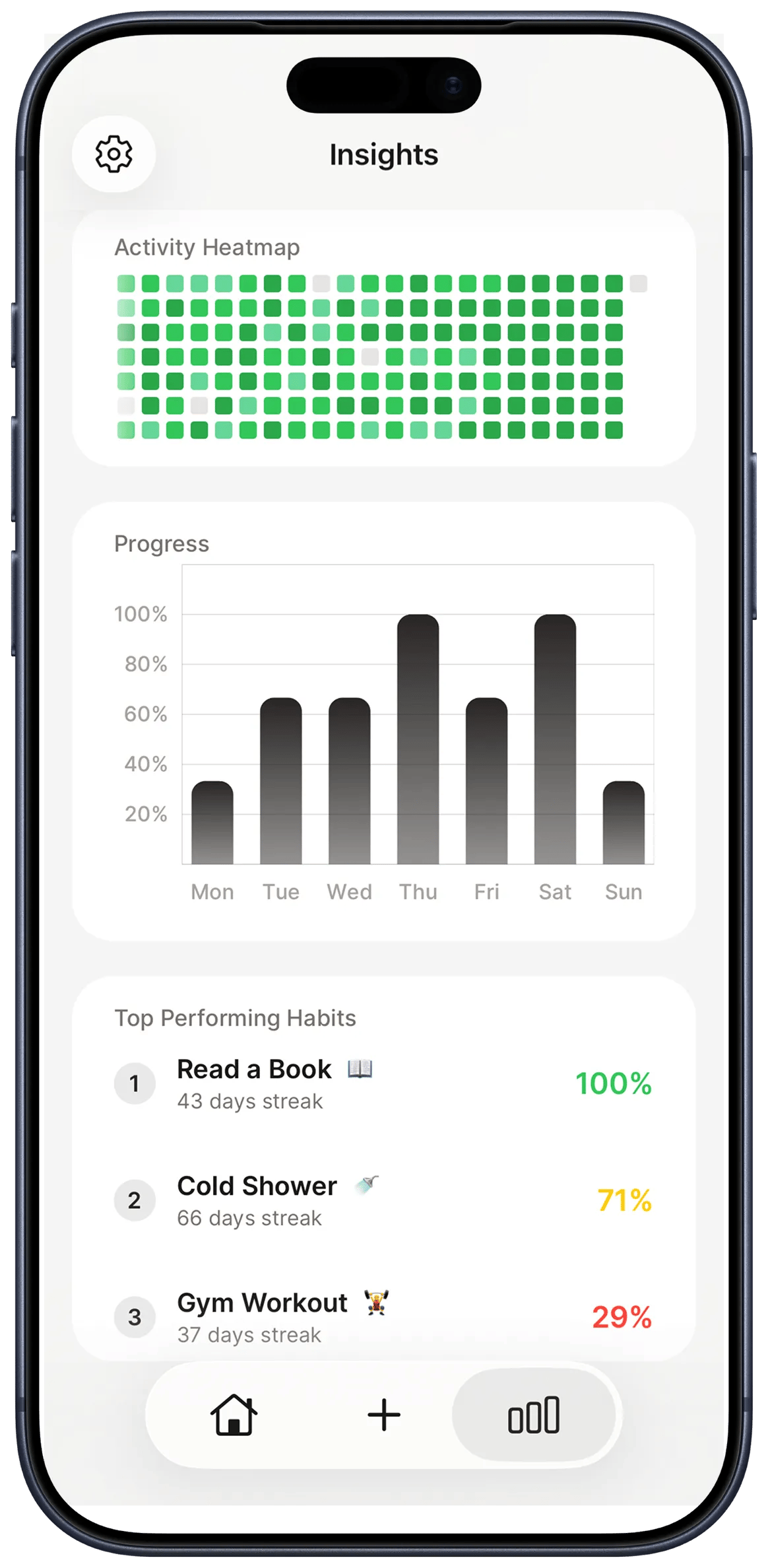
Habit Tracking Methods: App vs Paper vs Spreadsheet
There is no single best method for habit tracking — the best method is the one you'll actually use. That said, each approach has distinct strengths and trade-offs.
Mobile Apps
Best for: people who always have their phone, want reminders, and prefer visual progress displays.
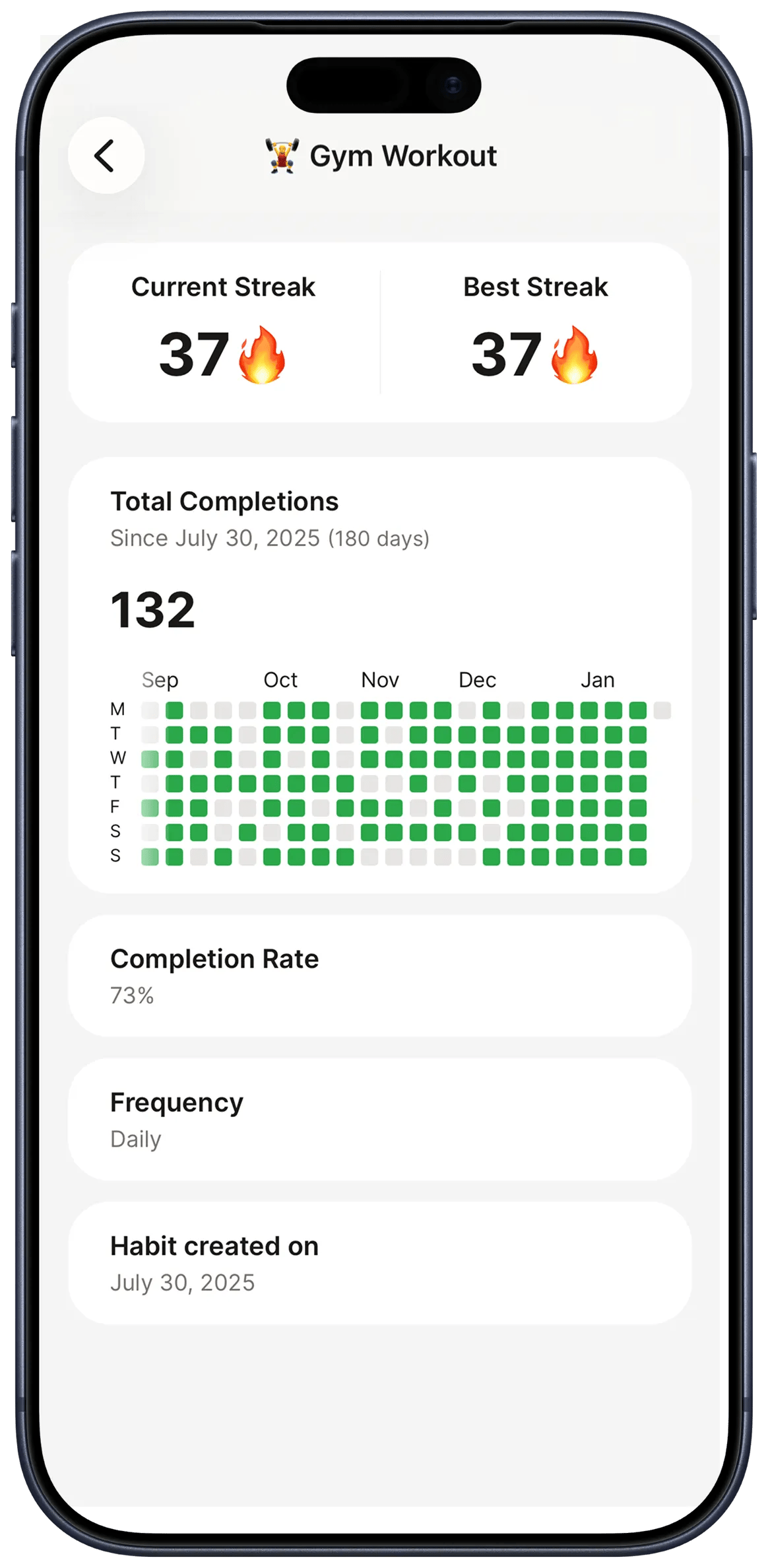
Mobile habit tracking apps like Habit Streak offer automatic reminders, streak counting, heatmaps, home screen widgets, and data insights. Research shows that over 55% of daily habit tracker users rely on streak tracking and reminders as their primary engagement features.
Pros:
- Always in your pocket
- Push notifications as cues
- Visual streak data and heatmaps
- Widgets keep habits visible throughout the day
Cons:
- Phone can be a distraction
- Free tiers may limit habit count
- Requires comfort with digital tools
Paper Journals and Bullet Journals
Best for: people who enjoy handwriting, want a phone-free system, and find physical writing more satisfying.
The bullet journal community popularized paper habit tracking with monthly grids and colorful layouts. The tactile act of filling in a square with pen can feel more rewarding than tapping a screen.
Pros:
- No screen time added
- Fully customizable layouts
- The physical act of writing reinforces memory
Cons:
- Easy to forget if not part of an existing routine
- No reminders or automation
- Harder to review long-term trends
Spreadsheets
Best for: data-oriented people who want full control over metrics and analysis.
Google Sheets or Excel let you build custom tracking grids with conditional formatting, formulas for completion rates, and charts for trend analysis.
Pros:
- Complete customization
- Built-in data analysis tools
- Free and accessible from any device
Cons:
- Requires setup effort
- Less satisfying moment-to-moment
- No built-in reminders
For a deeper comparison, see our article on digital vs paper habit tracking.
How to Choose the Right Habits to Track
Start with 3-5 habits maximum. Research and practical experience both point to the same conclusion: trying to track too many habits at once leads to overwhelm and abandonment. You can read more about the ideal number in our guide on how many habits to track at once.
Criteria for Choosing Trackable Habits
Not every goal makes a good tracked habit. The best habits to track share these characteristics:
- Binary and clear. You either did it or you didn't. "Exercise" is vague. "Do 20 minutes of exercise" is trackable.
- Daily or near-daily. Habits that happen every day build momentum faster than weekly ones. Lally's research specifically studied daily behaviors.
- Within your control. "Lose 2 pounds" is an outcome. "Eat a salad for lunch" is a behavior you control.
- Meaningful to you. If a habit doesn't connect to something you genuinely care about, no amount of tracking will sustain it.
The Habit Stacking Advantage
One proven strategy is to attach new habits to existing ones — a technique called habit stacking. For example: "After I pour my morning coffee, I will journal for 5 minutes." The existing habit (coffee) becomes the cue for the new one (journaling). When you track a stacked habit, you're really just monitoring whether the chain held.
Start Smaller Than You Think
BJ Fogg, Stanford behavior scientist, recommends making habits "tiny" — so small they feel almost trivial. Want to build a flossing habit? Start by flossing one tooth. Want to meditate? Start with one breath. The Tiny Habits method works because it removes the friction of getting started. Once tracking confirms the pattern, you naturally expand.
Setting Up Your Habit Tracking System
A good tracking system has three components: a clear list of habits, a defined trigger for each, and a specific time you'll review your tracker.
Step 1: Define Your Habits Precisely
Write each habit as a specific, observable action:
- "Drink 8 glasses of water" instead of "drink more water"
- "Read for 15 minutes before bed" instead of "read more"
- "Walk 10 minutes after lunch" instead of "be more active"
Step 2: Assign a Cue to Each Habit
Every habit needs a trigger. The most reliable cues are:
- Time-based: "At 7:00 AM, I meditate for 5 minutes."
- Action-based: "After I brush my teeth, I do 10 pushups."
- Location-based: "When I sit at my desk, I write 200 words."
Step 3: Choose Your Tracking Tool
Pick one method — app, paper, or spreadsheet — and commit to it for at least two weeks before evaluating. Switching tools too early creates friction.
If you choose an app, tools like Habit Streak let you set up home screen widgets that make your habits visible every time you unlock your phone.
Step 4: Set a Daily Review Time
The single most important habit to build is the habit of reviewing your tracker. Pick a consistent time — morning to plan the day, or evening to reflect — and spend 60 seconds checking off completed habits. This review moment is what turns a list into a system.
Step 5: Start and Iterate
Begin tracking tomorrow. Don't wait for the perfect setup. After one week, evaluate: Are the habits too ambitious? Too easy? Is the tracker convenient enough? Adjust and keep going. The first month is about building the tracking habit itself. Everything else follows.
Common Habit Tracking Mistakes to Avoid
The most damaging mistake isn't missing a day — it's quitting after missing a day. Here are the seven most common errors and how to fix them.
1. Tracking Too Many Habits at Once
Starting with 10+ habits is a recipe for overwhelm. The cognitive cost of managing a long list drains the motivation you need for the habits themselves. Start with 3-5. Add more only after your current habits feel automatic. For more on this, see habit tracking mistakes that kill your progress.
2. Making Habits Too Vague
"Be healthier" or "be more productive" can't be tracked. Every tracked habit needs a clear yes/no definition. If you can't answer "Did I do this today?" with a definitive yes or no, refine it.
3. Chasing Perfection
An all-or-nothing mindset is the number one habit killer. Lally's research showed that missing one day doesn't derail habit formation. What matters is your batting average, not your perfect game. Broken streaks aren't failures — they're data.
4. Not Using Reminders
Memory is unreliable. If you only remember to track when you happen to think of it, you'll forget more often than you remember. Set alarms, use app notifications, or place your journal where you can't miss it.
5. Ignoring the Data
Tracking without reviewing is just busywork. At the end of each week, spend 5 minutes looking at your completion rates. Which habits are sticking? Which are struggling? The patterns in your data tell you where to adjust.
6. Letting the Tracker Become the Goal
The purpose of tracking is behavior change, not a perfect scorecard. If you find yourself doing a habit poorly just to check the box — rushing through a meditation, walking in circles for step count — the tracker is controlling you instead of serving you.
7. Never Updating Your Habits
Your habit list should evolve. Once a habit is fully automatic, retire it from your tracker and add a new one. Keeping "brush teeth" on your list for months wastes tracker real estate on a behavior that no longer needs monitoring.
How to Stay Consistent With Habit Tracking
Consistency comes from making tracking easy, visible, and satisfying — not from willpower.
Make It Obvious
Keep your tracker where you'll see it. If you use an app, put a habit tracking widget on your home screen. If you use paper, leave your journal on your pillow or next to your coffee maker.
Make It Easy
Reduce friction at every step. One-tap check-offs beat long forms. A simple yes/no tracker beats an elaborate scoring system. The faster you can record, the more likely you'll do it.
Build a Streak (But Don't Worship It)
Streaks work because they create psychological momentum. A 30-day streak makes you think twice before breaking it. But if you do break it, the "never miss twice" rule is your safety net: one missed day is a rest, two missed days is the start of a new (bad) habit.
Use Accountability
Matthews' study showed that people who shared weekly updates with a friend were significantly more successful at reaching their goals. You don't need a formal accountability partner — even telling a friend "I'm tracking my water intake this month" adds a layer of social commitment.
Celebrate Small Wins
Don't wait until you hit 100 days to feel good about your progress. Each completed day is evidence that you're building the identity you want. Take a moment to notice it.
Review and Adjust Weekly
Every Sunday (or whatever works), review the past 7 days:
- What's working? Keep doing it.
- What's struggling? Make it smaller or change the cue.
- What's no longer relevant? Remove it.
This weekly review keeps your system alive. Without it, your tracker slowly becomes a guilt list.
Track your habits and build lasting streaks
Download FreeGetting Started: Your First Week of Habit Tracking
Here's a practical plan to start habit tracking today:
Day 1: Pick 3 habits you want to build. Write them as specific, binary actions. Choose your tracking tool.
Days 2-3: Track your habits. Don't worry about perfection. Just record honestly.
Day 4: Notice what's easy and what's hard. Adjust any habit that feels too ambitious — make it smaller.
Days 5-7: Keep tracking. Review your first week. Celebrate every checkmark.
Week 2 and beyond: Continue. Add a new habit only when the current ones feel natural. Check in weekly.
If you want a guided start, our getting started with Habit Streak tutorial walks you through setting up your first habits, configuring reminders, and using widgets to stay on track.
The most important thing to remember: you don't need to be perfect. You need to be consistent. Habit tracking isn't about never missing a day. It's about having a system that brings you back when you do.
Frequently Asked Questions
What is the best way to track habits?▼
The best method is the one you'll use consistently. Mobile apps work well for most people because of built-in reminders and streak tracking. Paper journals suit those who prefer handwriting. The key features to look for are simplicity, reminders, and visual progress displays.
How many habits should I track at once?▼
Start with 3-5 habits. Research shows that tracking too many habits leads to overwhelm and abandonment. Once your current habits feel automatic (typically after 2-3 months), you can add more.
Does habit tracking actually work?▼
Yes. A meta-analysis of 138 studies found that monitoring goal progress significantly increases the likelihood of achieving goals. Self-monitoring is one of the most validated behavior change techniques in psychology.
What should I do if I break my streak?▼
Don't quit. Research from UCL shows that missing one day does not derail the habit formation process. Follow the 'never miss twice' rule: get back on track the very next day. A broken streak is data, not failure.
How long does it take for habit tracking to show results?▼
Most people notice improved consistency within the first 2 weeks. Forming the habit itself takes an average of 66 days according to research, with a range of 18 to 254 days depending on the behavior's complexity.
- 1.Does monitoring goal progress promote goal attainment? A meta-analysis of the experimental evidencepubmed.ncbi.nlm.nih.gov
- 2.Digital Behavior Change Intervention Designs for Habit Formation: Systematic Reviewjmir.org
- 3.Phillippa Lally's landmark 2009 studyonlinelibrary.wiley.com
- 4.The Impact of Commitment, Accountability, and Written Goals on Goal Achievementscholar.dominican.edu
- 5.Habit Tracking Apps Market Sizebusinessresearchinsights.com