 By Adrien Blanc
Digital vs Paper Habit Tracking: Which Is Better?
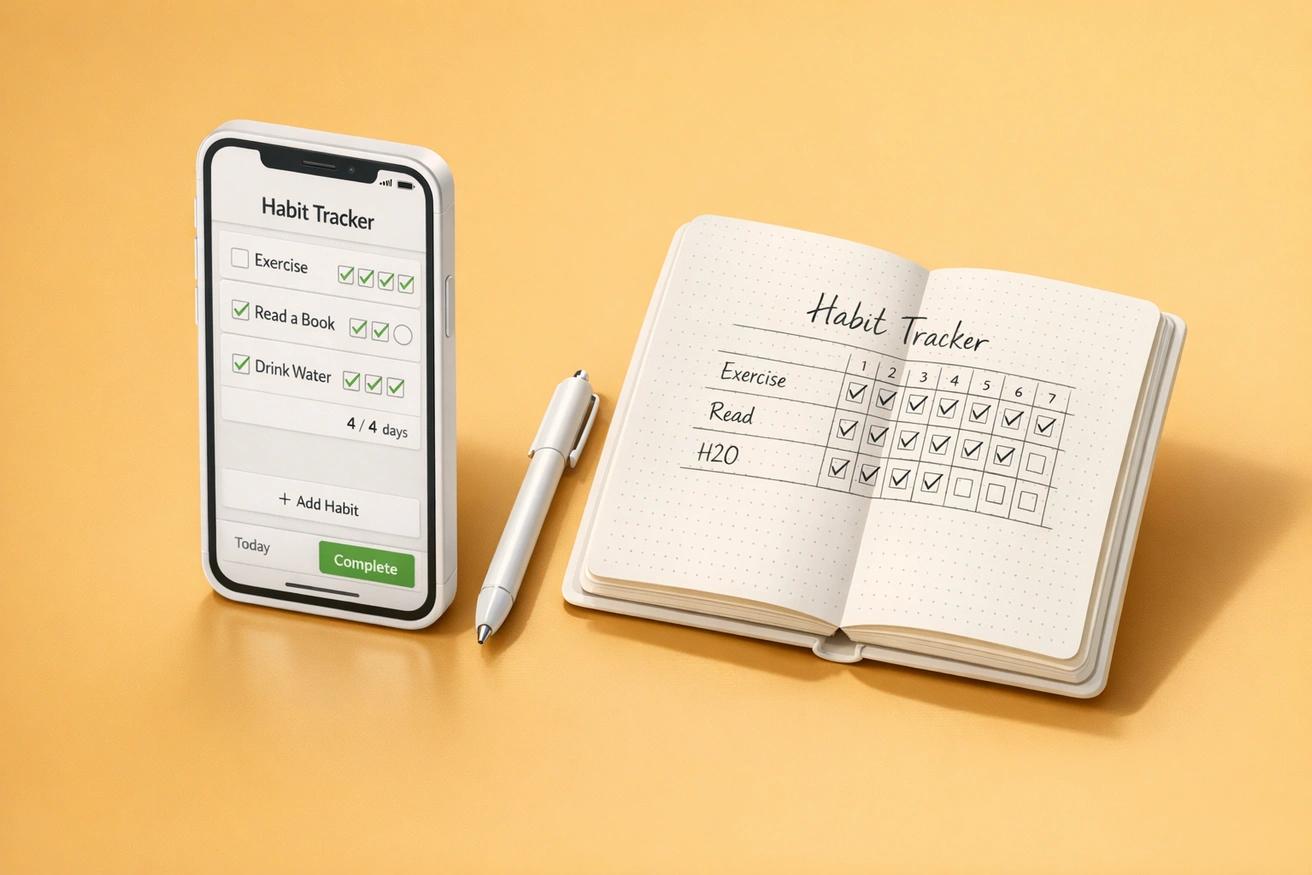
The best habit tracking method is the one you actually use every day — but digital and paper each have measurable advantages depending on your personality, goals, and how many habits you track. A 2019 study in Psychological Science found that people who tracked a target behavior were 42% more likely to maintain it after eight weeks compared to those who relied on memory alone. That effect — known as the "measurement effect" — works whether you use an app or a notebook. Yet how you track shapes what happens next. Research from the Norwegian University of Science and Technology shows that handwriting activates far more brain connectivity than typing, strengthening memory and encoding. Meanwhile, digital trackers offer automated reminders and data analytics that paper simply cannot match. This guide compares both methods with research, so you can pick the approach — or hybrid — that fits you.
42%
more likely to maintain a behavior when tracking it
Try digital habit tracking free for 5 habits
Download Free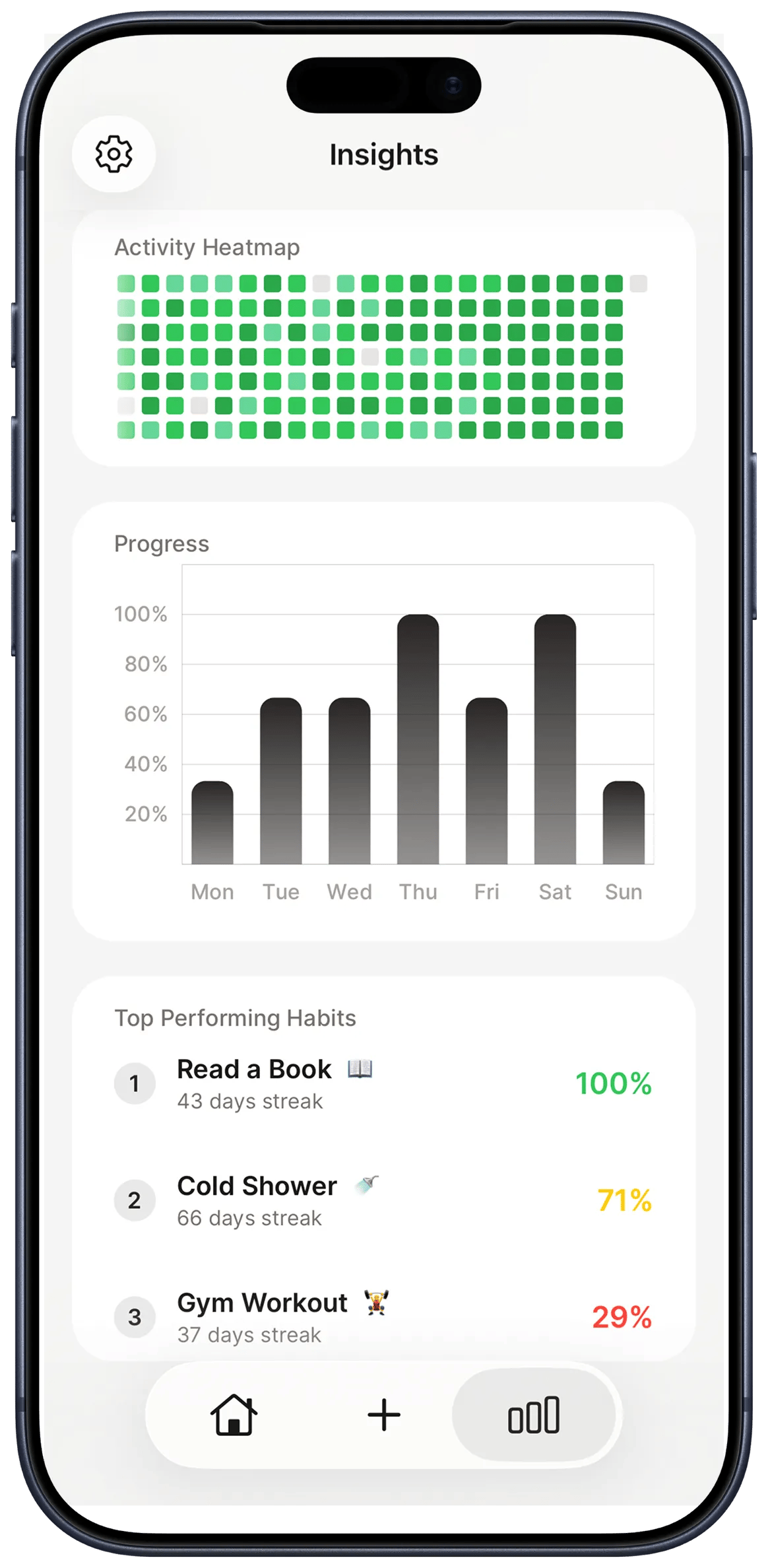
How Digital Habit Tracking Works
A digital habit tracker is an app on your phone or computer that records habit completions, sends reminders, and visualizes your progress over time. Most apps use a daily checklist format: you open the app, tap each habit you completed, and the app logs the data automatically.
The core features that separate digital trackers from paper include:
- Automated reminders. Push notifications at the exact time you want to perform a habit. A 2024 systematic review in ScienceDirect found that digital behavior change interventions using timely prompts significantly improved habit adherence.
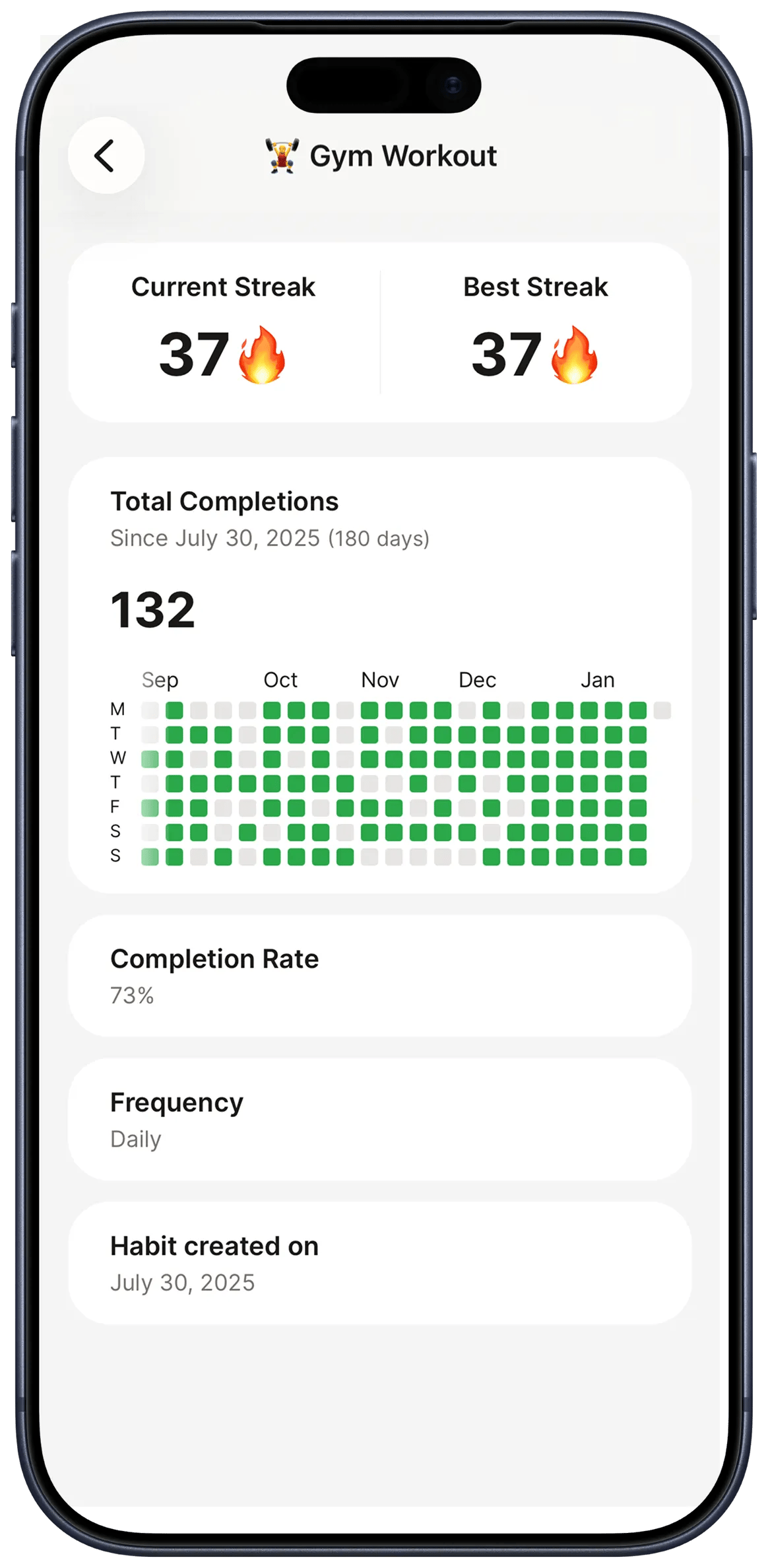
- Streak counting. Apps calculate consecutive days automatically, removing the mental math and creating a visual motivator.
- Data and analytics. Completion rates, heatmaps, and trend graphs help you spot patterns — like realizing you skip your meditation habit every Thursday.
- Cross-device syncing. Your data lives in the cloud, accessible from your phone, tablet, or widget.
The habit tracking app market reflects growing demand: the industry is projected to grow at a 14.2% annual rate through 2033, with over 118 million users worldwide relying on these tools for daily tracking.
For a full walkthrough of what habit tracking is and why it works, see our complete guide to habit tracking.
How Paper Habit Tracking Works
Paper habit tracking means recording your habits by hand — in a bullet journal, planner, printable template, or simple notebook. The most popular format is a monthly grid where habits run down the left column and dates run across the top. You fill in or cross off each cell as you complete a habit.
The format varies widely:
- Bullet journals. Custom-designed monthly or weekly spreads with colored grids, doodles, and personal layouts. The act of designing the spread itself builds commitment.
- Printable templates. Pre-made PDFs you print and fill in daily. Low setup, easy to start.
- Simple checkmarks. A plain notebook with a list and a check each day. No design required.
What makes paper different from apps is the physical act itself. A 2023 study from the Norwegian University of Science and Technology measured brain activity while participants handwrote versus typed words. Handwriting produced widespread brain connectivity across visual, sensory, and motor regions — connectivity patterns that are "crucial for memory formation and for encoding new information." Typing produced minimal activity in those same areas.
This has a practical implication for habit tracking: writing down "meditated 10 min" by hand may encode the behavior more deeply than tapping a button, reinforcing your identity as someone who meditates.
Pros and Cons of Digital Habit Tracking
Digital trackers excel at automation, scale, and long-term data. Here is where they shine and where they fall short.
Advantages
- Reminders prevent forgetting. The single biggest reason habits fail is forgetting to do them. Push notifications solve this.
- Handles many habits at once. If you track 5-10 habits, apps manage the complexity without visual clutter. Paper grids get cramped beyond 5 or 6 habits.
- Provides actionable data. Seeing your completion rate drop from 85% to 60% over two weeks tells you something is wrong — before you lose momentum entirely.
- Streak motivation. Research on why streaks work shows that visible streak counts create a psychological commitment to keep the chain going.
- Always with you. Your phone is already in your pocket. No separate journal to carry or forget at home.
Disadvantages
- Screen time concern. Opening a habit tracker app can lead to checking social media, email, or news. For people who struggle with phone overuse, this is a real risk.
- Drop-off rates are high. Industry data shows a 52% drop-off rate within the first 30 days for habit tracking apps. The ease of downloading an app also means the ease of abandoning it.
- Notification fatigue. Too many reminders can backfire, causing you to dismiss or disable them.
- Less personal engagement. Tapping a button requires less cognitive effort than handwriting, which means less deep encoding of the behavior.
Pros and Cons of Paper Habit Tracking
Paper tracking excels at mindfulness, creativity, and keeping you off your phone. Here is the full picture.
Advantages
- Deeper cognitive engagement. The neuroscience research is clear: handwriting activates memory-formation pathways that typing does not. Each time you hand-write a checkmark or note, you reinforce the habit more deeply.
- No screen time. Paper tracking is completely disconnected from your phone. For people trying to reduce screen time, this is a major advantage.
- Creative expression. Designing a bullet journal spread can be enjoyable in itself, turning tracking into a hobby rather than a chore.
- Tactile satisfaction. There is a reason people love crossing items off lists. The physical act of marking a checkbox with a pen triggers a small reward response.
Disadvantages
- No reminders. Paper cannot send push notifications. If you forget to check your journal, your habits go unrecorded — and possibly undone.
- Limited data analysis. You can see your monthly grid, but calculating completion percentages, spotting long-term trends, or comparing habits across months requires manual counting.
- Portability friction. You need to carry your journal and a pen. If you forget it at home, your tracking system breaks.
- Setup takes time. Bullet journal spreads can take 30 minutes or more to create each month. For some people this is a feature; for others, it is a barrier.
- Hard to scale. Tracking more than five or six habits on a paper grid becomes visually cluttered and tedious to maintain.
Digital vs Paper: Side-by-Side Comparison
| Feature | Digital | Paper |
|---|---|---|
| Reminders | Automatic push notifications | None — relies on memory |
| Data & analytics | Built-in charts, streaks, heatmaps | Manual counting only |
| Memory encoding | Lower — tapping a button | Higher — handwriting activates more brain regions |
| Screen time impact | Increases phone usage | Zero screen time |
| Portability | Always on your phone | Must carry journal |
| Scalability | Handles 10+ habits easily | Gets cluttered beyond 5-6 |
| Setup time | Minutes | 30+ min for bullet journal spreads |
| Cost | Free or $3-10/month premium | Cost of journal and pens |
| Customization | Predefined layouts | Unlimited creative freedom |
| Drop-off risk | 52% quit within 30 days | Lower — physical investment creates commitment |
Who Should Use a Digital Habit Tracker
Digital tracking fits best if you need reminders, track multiple habits, or want data to analyze. Specifically, choose digital if:
- You track 4 or more habits. Apps handle the complexity without visual clutter. They also prevent the "forgot to check my journal" problem that kills paper systems when life gets busy.
- You want accountability through streaks. The psychology of not wanting to break a visible streak is powerful. Research shows that streak-based motivation taps into loss aversion — we hate losing progress more than we enjoy gaining it.
- You are data-driven. If seeing a 92% completion rate motivates you more than a hand-drawn checkmark, apps are your match.
- You already have a healthy relationship with your phone. If opening your phone to log a habit does not spiral into 20 minutes of social media, digital tracking will not create new problems.
- You travel frequently. No extra items to carry — just your phone.
For a step-by-step guide to setting up digital tracking, see getting started with Habit Streak.
Who Should Use Paper Habit Tracking
Paper tracking fits best if you value mindfulness, want less screen time, or enjoy the creative process. Choose paper if:
- You track 1-3 habits. A simple checklist in a notebook is fast and satisfying. The overhead of an app may not be worth it for just one or two habits.
- You struggle with phone addiction. If your phone is a source of distraction rather than a tool, adding another reason to open it is counterproductive.
- You enjoy journaling or bullet journaling. If designing spreads is part of your self-care routine, paper tracking becomes intrinsically rewarding — not just a means to an end.
- You want deeper reflection. Paper naturally invites you to add notes alongside your checkmarks. "Meditated 10 min — felt calmer after" adds qualitative data that most apps do not capture well.
- You learn or process information better by writing. If you are someone who remembers things better when you write them down, the neuroscience supports your instinct.
Can You Combine Both Methods? The Hybrid Approach
Many successful habit trackers use both digital and paper — and there is good reason to. A hybrid approach lets you capture the reminders and data of digital tracking while preserving the cognitive benefits of handwriting.
How to set up a hybrid system
- Use a digital app for reminders and streaks. Set notifications for the times you want to perform each habit. Let the app handle streak counting and long-term data.
- Use paper for daily reflection. At the end of each day, spend two minutes writing in a journal: which habits you completed, how you felt, and what you want to adjust tomorrow.
- Weekly review on paper. Once a week, write out your completion rates and observations by hand. This engages the deeper memory encoding that typing misses.
Why hybrid works
The hybrid method addresses the two biggest failure modes:
- Digital drop-off: The physical journal creates a ritual that keeps you engaged even when app fatigue sets in.
- Paper forgetting: The app's reminders ensure you actually do the habits, while the journal captures the reflection.
Start tracking your habits with daily reminders
Download FreeHow to Choose the Right Method for You
Your ideal tracking method depends on three factors: how many habits you track, your relationship with technology, and whether you value data or reflection more.
Ask yourself these questions:
- How many habits am I tracking? 1-3 habits: paper works fine. 4 or more: digital handles the complexity better.
- Do I struggle with phone overuse? If yes, paper protects your attention. If no, digital adds convenience.
- What motivates me more — streaks and data, or the act of writing? Data people go digital. Reflection people go paper.
- Will I carry a journal daily? If no, digital is more reliable since your phone is always with you.
- Am I building new habits or maintaining established ones? New habits benefit from digital reminders. Established habits may need only a paper check-in.
Whatever method you choose, the most important thing is consistency. Research on the science of building healthy habits consistently shows that the act of tracking itself — regardless of medium — significantly increases your chances of sticking with a behavior.
52%
of app users drop off within 30 days
The method you will actually use every single day is the best method. If a beautifully designed bullet journal makes you excited to track, use paper. If a three-second tap on your phone is all you can commit to, use digital. If both appeal to you, combine them. The research supports all three approaches — what it does not support is not tracking at all.
Frequently Asked Questions
Is a habit tracker app better than a paper journal?▼
Neither is universally better. Apps excel at reminders, streaks, and handling multiple habits. Paper excels at deeper memory encoding and keeping you off your phone. Research shows the measurement effect — simply tracking a behavior — works equally well with both methods. Choose based on how many habits you track and your relationship with technology.
Does writing habits by hand make them more effective?▼
There is evidence it helps with encoding. A 2023 study from the Norwegian University of Science and Technology found that handwriting activates widespread brain connectivity across visual, sensory, and motor regions — patterns crucial for memory formation. This suggests that writing habits by hand may reinforce them more deeply than tapping a screen, though both methods improve consistency compared to not tracking.
How many habits should I track at once?▼
Start with three to five, regardless of whether you use an app or paper. Research suggests aiming for an 80% completion rate before adding more. Digital apps handle more habits without visual clutter, but tracking too many at once — on any medium — leads to overwhelm and abandonment.
What is the best free habit tracker app?▼
Look for an app with daily reminders, streak tracking, and a simple check-in interface. Habit Streak offers free tracking for up to five habits with streaks, widgets, and smart reminders. The most important feature is not the app itself but whether it fits naturally into your daily routine.
Can I use both a habit tracker app and a paper journal?▼
Yes, and many people find this hybrid approach most effective. Use the app for automated reminders, streak counting, and long-term data. Use paper for daily or weekly reflection — writing down how you felt and what you want to adjust. This captures the cognitive benefits of handwriting alongside the convenience of digital tools.
- 1.2019 study in Psychological Sciencejournals.sagepub.com
- 2.Frontiers | Handwriting but not typewriting leads to widespread brain connectivity: a high-density EEG study with imp...frontiersin.org
- 3.2024 systematic review in ScienceDirectsciencedirect.com
- 4.Habit Tracker App Market Reportdataintelo.com
- 5.Habit Tracking Apps Market Size, Share, Growth & Trends Chart by 2033straitsresearch.com
- 6.Why Writing by Hand Is Better for Memory and Learningscientificamerican.com
- 7.Loss aversion - Wikipediaen.wikipedia.org
- 8.The Neuroscience Behind Writing: Handwriting vs. Typing—Who Wins the Battle?pmc.ncbi.nlm.nih.gov