 By Adrien Blanc
The Science of Building Healthy Habits That Last
Building healthy habits isn't about willpower — it's about working with your brain, not against it. Neuroscience research has revealed that habits are driven by specific neural circuits, chemical signals, and environmental cues that operate largely outside conscious awareness. Understanding these mechanisms is the difference between forcing a behavior and letting it become automatic. According to research by psychologist Wendy Wood at USC, approximately 43% of our daily actions are performed habitually, with minimal conscious thought. That means nearly half of your day is already running on autopilot — the question is whether those autopilot behaviors are serving you.
This guide breaks down the neuroscience of habit formation: how the habit loop works, what happens inside your brain as a behavior becomes automatic, why the "21 days" myth is wrong, and what evidence-based strategies actually produce lasting change. Whether you want to exercise more, meditate daily, eat better, or start tracking your habits, the science points to a clear set of principles that work.
43%
of daily behaviors are performed habitually
The Habit Loop: Cue, Craving, Response, Reward
Every habit follows a four-stage neurological loop. This framework, expanded by James Clear from Charles Duhigg's original three-step model, explains how your brain converts repeated behaviors into automatic routines.
Here's how it works:
-
Cue. An environmental or internal signal triggers the process. This could be a time of day (7:00 AM), a location (your kitchen), a preceding action (finishing dinner), or an emotional state (feeling stressed). Multiple brain regions respond to cues — the amygdala processes the emotional significance, the hippocampus supplies past context, and dopaminergic pathways begin anticipating the reward.
-
Craving. The cue sparks a desire — not for the behavior itself, but for the change in state it delivers. You don't crave the act of running; you crave the endorphin rush, the sense of accomplishment, or the relief from restless energy. Cravings supply the motivational force behind every habit.
-
Response. This is the behavior itself — the habit you actually perform. Whether you act depends on your ability (is it easy enough?) and your motivation (is the craving strong enough?). The easier the response, the more likely it happens.
-
Reward. Completing the behavior delivers a neurochemical payoff, primarily through dopamine release. This reinforces the cue-craving-response connection, making the loop more likely to fire again next time.
The loop is self-reinforcing. Each cycle strengthens the neural pathways connecting the four stages. Miss the cue, and the loop never starts. Remove the reward, and the loop weakens. Change the response, and you can redirect the entire pattern — which is exactly how you replace bad habits with better ones.
How Your Brain Builds Automatic Behaviors
Habits form through a gradual neurological shift from conscious decision-making to automatic processing. When you first perform a new behavior — say, going for a morning run — your prefrontal cortex works hard. It weighs options, overrides the impulse to stay in bed, and directs your body through each step. This requires significant mental energy.
With repetition in a consistent context, something changes. Neural activity gradually migrates from the prefrontal cortex to the basal ganglia, a cluster of structures deep in the forebrain that specializes in automatic, procedural behaviors. Recent neuroscience research has isolated the dorsolateral striatum (DLS) as the specific region where habit sequences are stored and executed independently of conscious decision-making.
This migration is why habits feel effortless once established. Your brain has literally delegated the behavior to a different processing center — one that operates faster, uses less energy, and doesn't require you to "decide" each time.
The Role of Neuroplasticity
Neuroplasticity — the brain's ability to reorganize by forming new neural connections — is what makes habit formation possible at any age. Each time you repeat an action in the same context, you strengthen the synaptic connections involved. These connections get reinforced through myelination, where repeated neural firing causes nerve fibers to develop a thicker insulating sheath, allowing signals to travel faster.
Think of it like a trail through a forest. The first time you walk it, you're pushing through brush. The tenth time, the path is visible. The hundredth time, it's a well-worn track you follow without thinking. Your brain builds habits the same way — through repeated use of the same neural pathways.
Importantly, the basal ganglia doesn't distinguish between "good" and "bad" habits. Once a loop is encoded, the brain treats it as an efficiency measure. This is why unwanted habits are so persistent — and why replacing them with better alternatives (rather than trying to eliminate them through sheer willpower) is more effective. For strategies on breaking negative patterns, see our guide on how to break a bad habit.
The 21-Day Myth vs. the 66-Day Reality
It does not take 21 days to form a habit. This widely repeated claim originated from anecdotal observations by plastic surgeon Maxwell Maltz in the 1960s, who noticed that patients typically adjusted to their new appearance in about 21 days. Over time, "about 21 days to adjust" became "21 days to form any habit" — a misquotation that stuck.
The actual science tells a different story. In 2009, Phillippa Lally and her team at University College London conducted the first rigorous study of habit formation in everyday life. They recruited 96 volunteers, asked each to adopt a single new daily behavior, and tracked self-reported automaticity over 12 weeks.
66 days
average time to form a new habit
Their findings:
- The average time to reach automaticity was 66 days — more than three times the popular myth.
- The range was enormous: 18 to 254 days. Simple behaviors like drinking a glass of water became automatic quickly. Complex behaviors like doing 50 sit-ups before breakfast took much longer.
- Missing a single day did not materially affect the process. Participants who skipped one opportunity to perform the behavior still developed the habit at roughly the same rate. However, people who were highly inconsistent did not succeed.
A 2024 systematic review and meta-analysis from the University of South Australia further confirmed these findings, reporting median habit formation times of 59-66 days and mean times of 106-154 days, with substantial individual variability (4 to 335 days).
The practical takeaway: expect habit formation to take roughly 2-3 months of consistent daily practice. Don't get discouraged if a behavior doesn't feel automatic after a few weeks — that's normal, not a sign of failure. And if you miss a day, don't abandon the effort. Get back on track and keep building.
Identity-Based Habits: Becoming the Person You Want to Be
The most durable habits are rooted in identity, not outcomes. Most people approach habit change by focusing on what they want to achieve: lose 10 pounds, run a marathon, read 50 books. These are outcome-based goals. The problem is that outcomes don't sustain behavior once achieved — or when progress stalls.
James Clear proposes an alternative: identity-based habits. Instead of "I want to run a marathon," you adopt the belief "I am a runner." Instead of "I want to read more," you become "a person who reads every day." The shift is subtle but powerful.
This approach is supported by multiple psychological frameworks:
- Self-Perception Theory (Daryl Bem, 1972): We infer our own identity by observing our actions. If you see yourself running every morning, you start to believe you're a runner.
- Cognitive Dissonance (Leon Festinger, 1957): When your actions don't match your identity, your brain creates uncomfortable tension that pushes you to align the two. Once you identify as "someone who exercises," skipping a workout feels wrong.
- Identity framing research (Journal of Personality and Social Psychology, 2024): Framing habits in terms of identity ("I am a person who exercises daily") rather than outcomes improves adherence.
Every action you take is a vote for the type of person you want to become. A single workout doesn't transform your body, but it casts a vote for "I am someone who works out." Enough votes, and the identity becomes self-reinforcing — you do the behavior because it's who you are, not because you're chasing a specific result. This is why habit tracking is so effective: each checkmark is visible evidence of your new identity.
The Role of Dopamine in Habit Formation
Dopamine is not a "pleasure chemical" — it's a motivation and prediction chemical. This distinction matters for understanding how habits form and why they persist.
When you first perform a behavior and receive a reward, dopamine surges in response to the reward itself. But as the habit loop repeats, something crucial shifts: dopamine release moves earlier in the sequence, firing in response to the cue rather than the reward. Your brain learns to predict the reward before it arrives, and it's this anticipation — not the reward itself — that drives the behavior.
This is why habits feel automatic. The cue triggers a dopamine-fueled craving that propels you through the behavior without conscious deliberation. It's also why breaking habits is hard: the dopamine spike at the cue creates a motivational pull that's difficult to override with willpower alone.
How Dopamine Shapes Good and Bad Habits
Dopamine doesn't distinguish between beneficial and harmful behaviors. It reinforces whatever loop produces a reward:
- Scrolling social media: The cue (boredom) triggers a dopamine spike of anticipation. Each new post delivers a micro-reward, reinforcing the loop.
- Morning exercise: The cue (alarm at 6:30) gradually triggers anticipation of the post-workout high. Over time, the dopamine response at the cue makes getting up feel less painful.
The key difference is reward timing. Unhealthy habits tend to deliver immediate rewards (sugar, social media dopamine). Healthy habits often deliver delayed rewards (fitness, knowledge, calm). This mismatch is why building good habits requires making them immediately satisfying — even in small ways.
Practical strategies for working with dopamine:
- Stack immediate rewards onto healthy habits. Listen to a favorite podcast only while exercising. Enjoy a good coffee only after meditating.
- Use habit tracking as an instant reward. The act of checking off a completed habit provides a small but real dopamine hit, bridging the gap between effort and delayed outcomes.
- Start small to lower the dopamine threshold. A 5-minute walk is easy enough that completing it triggers satisfaction. That satisfaction builds the prediction loop for longer walks later.
Research from Georgetown University Medical Center published in Nature Communications (2025) found that shifting levels of a brain protein called KCC2 can reshape how cues become linked with rewards, sometimes causing habits to form more quickly or powerfully than expected — further confirming dopamine's central role in the habit formation process.
Build better habits with science-backed tracking
Download Free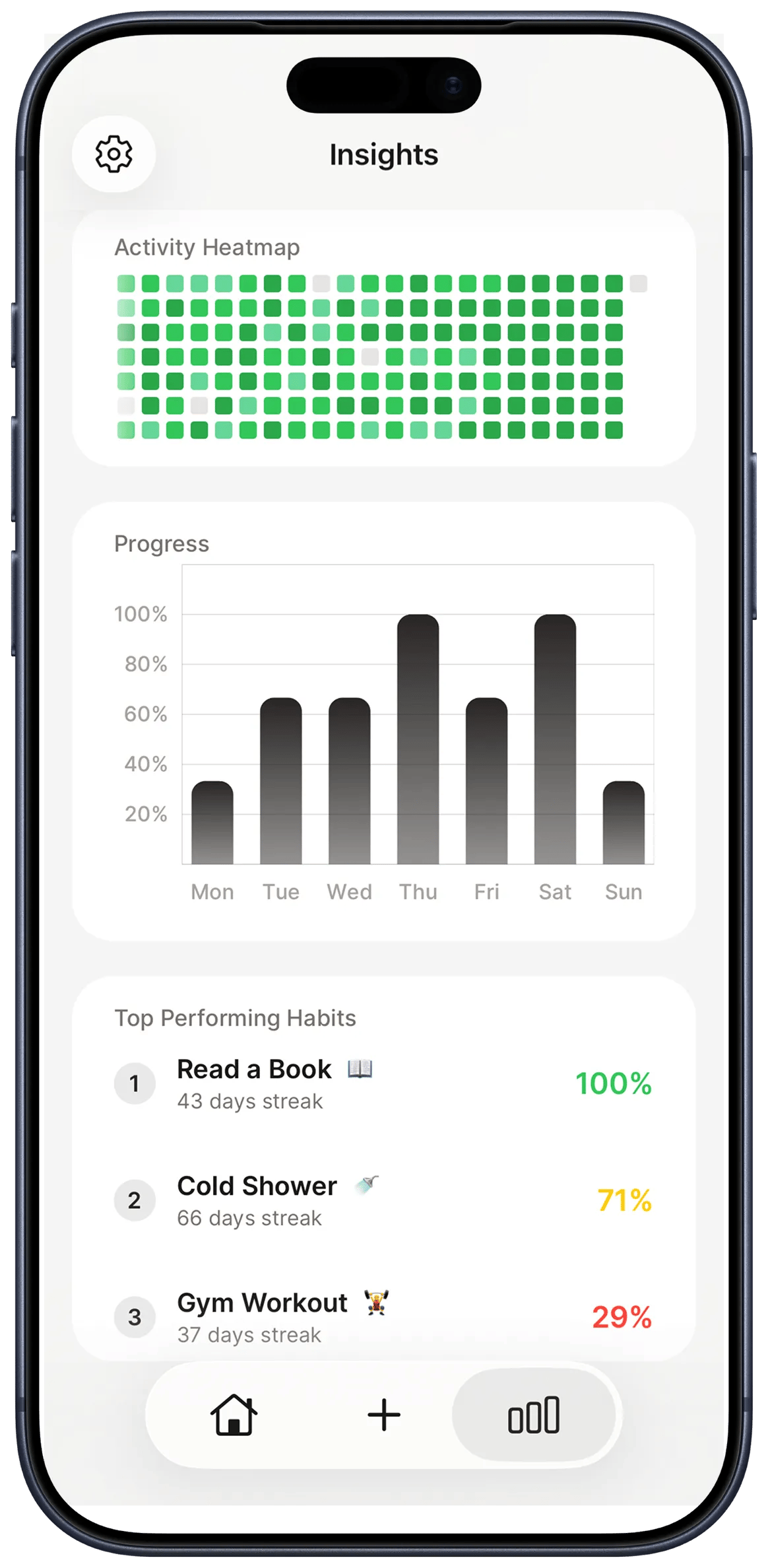
Evidence-Based Strategies for Lasting Change
Research points to a specific set of techniques that reliably produce lasting habit change. These aren't motivational tips — they're behavioral science findings backed by controlled studies.
1. Start Tiny
BJ Fogg's research at Stanford demonstrates that the most reliable path to habit formation is to make the behavior absurdly small. Want to meditate? Start with one breath. Want to exercise? Start with one pushup. Want to journal? Write one sentence.
The logic is sound: a tiny behavior requires no motivation, eliminates the friction of starting, and still activates the habit loop. Once the loop is established, you naturally expand. Learn more about this approach in our guide to the Tiny Habits method.
2. Use Habit Stacking
Attach a new habit to an existing one. This technique, formalized by James Clear and rooted in implementation intentions research, uses an established behavior as a cue for a new one.
The formula: "After I [CURRENT HABIT], I will [NEW HABIT]."
- After I pour my morning coffee, I will write three things I'm grateful for.
- After I sit down at my desk, I will set my three priorities for the day.
- After I put on my pajamas, I will prepare my clothes for tomorrow.
Research from the British Psychological Society found that people who used habit stacking reported 64% higher success rates than those who tried to build standalone habits. Read our full guide on habit stacking for more strategies.
3. Schedule Specific Time Blocks
A 2025 study of 300 executives found that those who scheduled specific time blocks for new habits were 3.2 times more likely to maintain them compared to those who tried to "fit them in." Morning time blocks were especially effective, with 78% of successful habit-formers completing key habits before 9 AM.
4. Track Your Progress
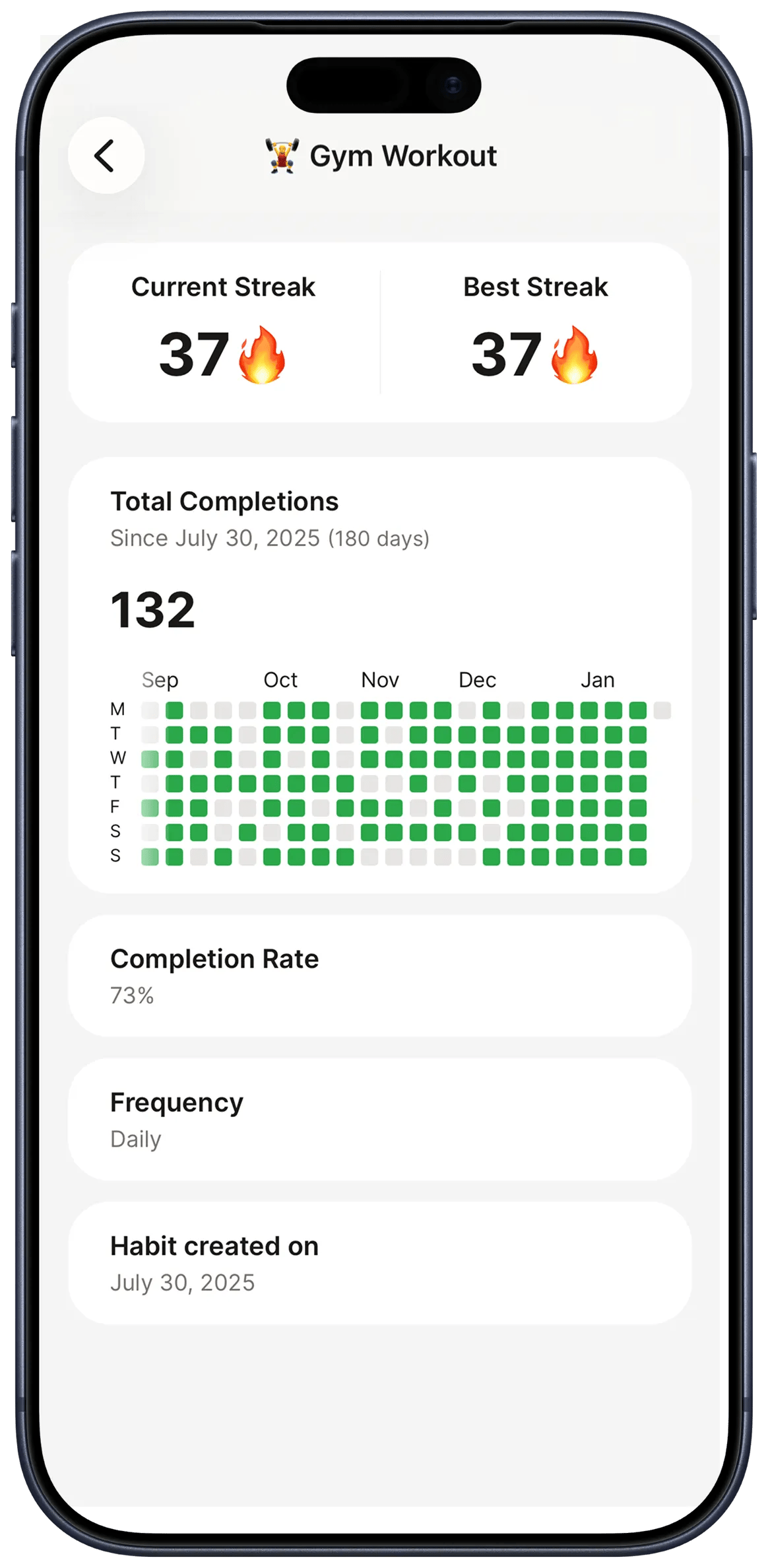
Self-monitoring is one of the most replicated behavior change techniques in psychology. A meta-analysis of 138 studies (N = 19,951) found that regularly monitoring progress significantly increased goal attainment. The more frequently people tracked, the better their outcomes. Start with a simple habit tracking system and build from there.
5. Apply the "Never Miss Twice" Rule
Lally's research showed that one missed day doesn't derail habit formation. The danger is in the second missed day, which often becomes the third, then a week, then abandonment. If you miss once, your only priority is showing up the next day — even in the smallest way.
6. Use Implementation Intentions
Research by psychologist Peter Gollwitzer shows that stating when, where, and how you'll perform a behavior roughly doubles the likelihood of follow-through compared to simply intending to do it. "I will meditate for 5 minutes at 7 AM in my living room" outperforms "I should meditate more."
How to Design Your Environment for Better Habits
Your environment shapes your behavior more powerfully than your motivation. Wendy Wood's research at Duke and USC has consistently shown that context cues — not goals, not willpower — are the primary drivers of habitual behavior.
Her studies demonstrated something striking: strong habits are triggered by environmental cues and are relatively unaffected by current goals or intentions. In one experiment, performance contexts automatically triggered habitual behaviors, while goals had no significant effect on strongly habitual actions. This means that once a habit is established, your environment runs the show.
Reduce Friction for Good Habits
The easier a behavior is to perform, the more likely it becomes habitual. Friction — the time, effort, and steps required — determines whether you follow through:
- Want to exercise in the morning? Sleep in your workout clothes. Put your shoes by the bed.
- Want to eat healthier? Prep vegetables on Sunday. Put fruit on the counter, cookies in the cabinet.
- Want to read before bed? Put a book on your pillow. Charge your phone in another room.
Google applied this principle across their offices: by placing healthy foods in transparent containers at eye level and less healthy options in opaque containers below eye level, they increased healthy food consumption by 30% — no motivation required.
Increase Friction for Bad Habits
The inverse works for habits you want to break:
- Want to stop mindless scrolling? Delete social media apps from your phone. Make yourself re-download and log in each time.
- Want to reduce snacking? Move snacks to a high shelf in a closed container. The 20 seconds of extra effort is enough to break the automatic loop.
- Want to stop hitting snooze? Put your alarm across the room.
Classic research found that simply slowing an elevator door's closing by 16 seconds was enough to shift people from taking the elevator to using the stairs. Small changes in friction produce outsized changes in behavior.
Design Cue-Rich Environments
Make the cues for your desired habits visible and the cues for unwanted habits invisible.
- Leave your journal open on your desk if you want to write daily.
- Fill a water bottle and place it where you work if you want to drink more water.
- Set out your meditation cushion in a visible spot if you want a daily meditation practice.
Your environment is not something that happens to you — it's something you design. Every room in your house, every screen on your phone, every surface on your desk is a collection of cues that either trigger productive habits or counterproductive ones. The most effective behavior change strategy is to spend less time fighting temptation and more time redesigning your surroundings.
Putting It All Together: Your Habit-Building Framework
Building lasting habits is a science, not a guessing game. Here's the framework distilled from everything above:
-
Choose one habit. Pick a single behavior that matters to you. Make it specific and binary: "Meditate for 5 minutes after my morning coffee."
-
Make it tiny. Shrink the habit until it feels almost too easy. You can always expand later — but you can't expand a habit you never started.
-
Design the environment. Place cues for the habit where you'll see them. Remove friction. Make the desired behavior the path of least resistance.
-
Stack it. Attach the new habit to an existing routine. Use the formula: "After I [existing habit], I will [new habit]."
-
Track it. Use a habit tracker — an app, a journal, a calendar on the wall. Each checkmark reinforces your identity and provides an immediate reward.
-
Never miss twice. Accept that imperfect days will happen. Your only job after a miss is to show up the next day.
-
Think in identity. Don't just do the habit — become the person who does it. "I am someone who moves every day" is more powerful than "I want to exercise more."
-
Be patient. The science says 66 days on average, with wide variation. Give yourself at least 2-3 months before judging whether a habit has stuck.
The brain is remarkably adaptable. Every repetition strengthens the neural pathway. Every day you show up, you're reshaping your basal ganglia, adjusting your dopamine predictions, and casting another vote for the person you're becoming. The science is clear — and it's on your side.
Start building better habits today
Download FreeFrequently Asked Questions
What is the habit loop?▼
The habit loop is a four-stage neurological pattern: cue (a trigger that initiates the behavior), craving (the motivation or desire), response (the behavior itself), and reward (the satisfying outcome). Each cycle strengthens the neural connections, gradually shifting processing from the prefrontal cortex to the basal ganglia, making the behavior increasingly automatic.
How long does it really take to form a habit?▼
According to Phillippa Lally's landmark 2009 study at University College London, the average time is 66 days — not 21 as commonly claimed. However, the range is 18 to 254 days depending on the behavior's complexity and the individual. A 2024 meta-analysis confirmed these findings. Expect roughly 2-3 months for most meaningful habits.
Can you build healthy habits at any age?▼
Yes. Neuroplasticity — the brain's ability to form new neural connections — persists throughout life. While forming new habits may take more repetition as you age, the fundamental mechanism works at any stage. Research shows that consistent practice in stable contexts leads to automaticity regardless of age.
Does missing a day ruin your habit?▼
No. Lally's research found that missing a single day did not materially affect the habit formation process. What matters is overall consistency, not perfection. The risk is missing two or more days in a row, which can break momentum. Follow the 'never miss twice' rule.
What is the most effective strategy for building habits?▼
Evidence points to a combination of techniques: start with a tiny version of the habit, stack it onto an existing routine, design your environment to support it, track your progress daily, and frame the habit as part of your identity rather than a goal to achieve. No single technique is a silver bullet — the combination produces the best results.
- 1.Psychology of Habitpubmed.ncbi.nlm.nih.gov
- 2.amygdala processes the emotional significanceintegrative-psych.org
- 3.Rewiring Your Brain for Better Habits: Understanding Dopamine, Reward Loops, and Real Changemindfulspark.org
- 4.migrates from the prefrontal cortex to the basal gangliaroutinearchitect.com
- 5.How long does it take to form a habit?ucl.ac.uk
- 6.Phillippa Lally and her team at University College Londononlinelibrary.wiley.com
- 7.Time to Form a Habit: A Systematic Review and Meta-Analysis of Health Behaviour Habit Formation and Its Determinantspmc.ncbi.nlm.nih.gov
- 8.APA PsycNetpsycnet.apa.org
- 9.Leon Festinger, 1957psycnet.apa.org
- 10.Journal of Personality and Social Psychology, 2024journals.sagepub.com
- 11.New research reveals how everyday cues secretly shape your habitssciencedaily.com
- 12.2025 study of 300 executivescoachpedropinto.com
- 13.Does monitoring goal progress promote goal attainment? A meta-analysis of the experimental evidencepubmed.ncbi.nlm.nih.gov
- 14.Key to Changing Habits Is In Environment, Not Willpower, Duke Expert Saystoday.duke.edu
- 15.increased healthy food consumption by 30%mindspacex.com