 By Adrien Blanc
The Psychology of Streaks: Why Counting Days Works

Streaks work because they hijack some of the most powerful forces in human psychology -- loss aversion, the progress principle, and identity reinforcement -- all at once. A 2025 study across six experiments with nearly 4,500 participants found that people completed more work when given streak incentives than when given larger, stable rewards. Participants in the streak condition earned less money overall, yet still outperformed the higher-paid group. That's how strong the pull of consecutive days can be.
This isn't a quirk of one study. Research on habit tracking consistently shows that self-monitoring improves outcomes, but adding a streak mechanic -- counting consecutive days rather than just total completions -- creates a fundamentally different motivational dynamic. The number itself becomes something you own, something you protect, and eventually something that shapes how you see yourself.
Here's why counting days is so effective, when it can backfire, and how to use streaks strategically.
2x
stronger: the pain of losing a streak vs. the pleasure of building one, per loss aversion research
Start building streaks backed by behavioral science
Download Free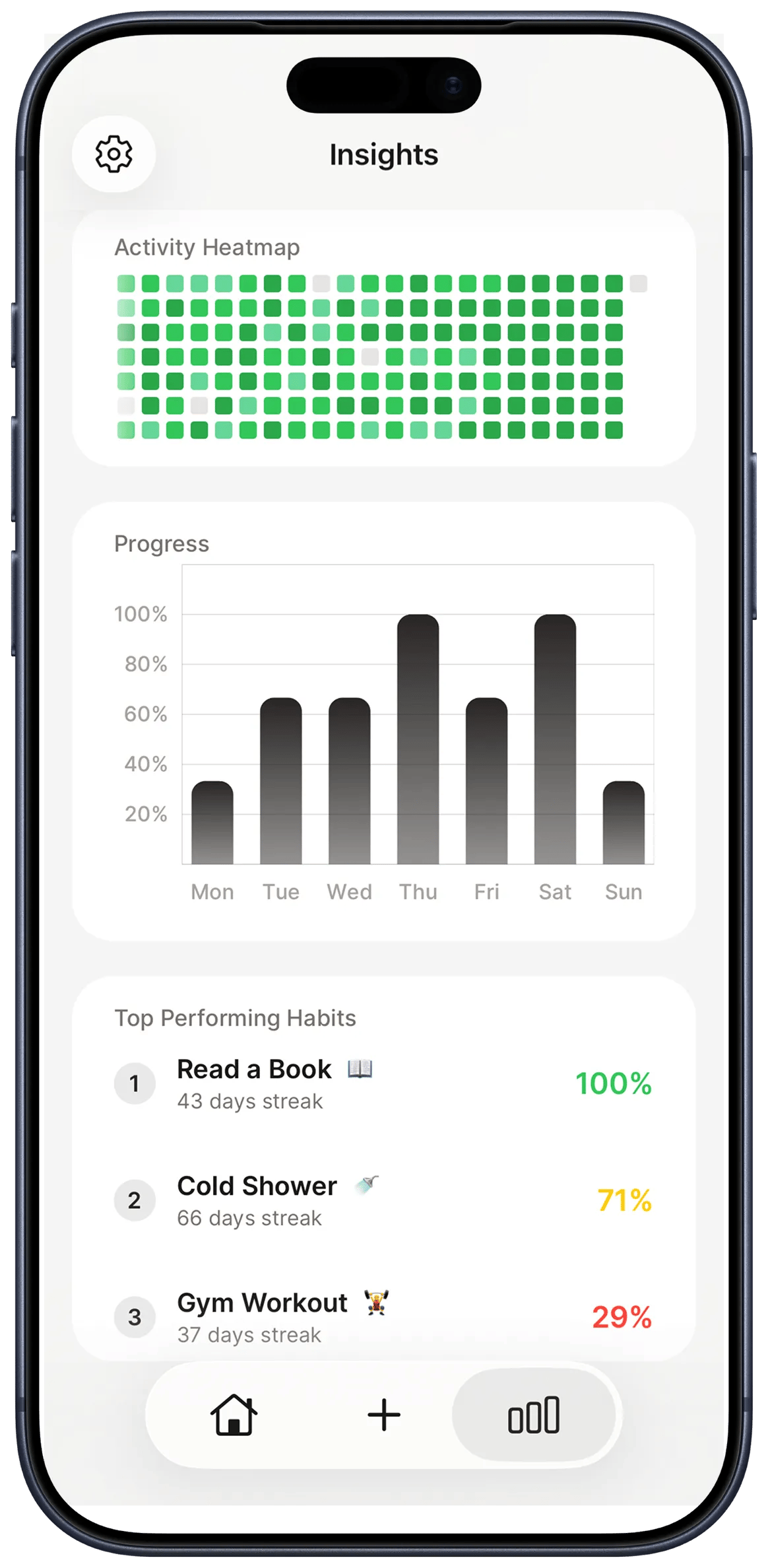
The Loss Aversion Effect on Streaks
You fear breaking your streak more than you enjoy extending it. That asymmetry is the core engine behind streak motivation.
Loss aversion, first documented by psychologists Daniel Kahneman and Amos Tversky, is one of the most replicated findings in behavioral economics. People feel the pain of losing something roughly twice as strongly as the pleasure of gaining something equivalent. When you've built a 30-day streak, the prospect of watching it reset to zero is genuinely painful -- not because of the number, but because of the effort it represents.
This is why streaks keep you going on your worst days. You might not feel motivated to meditate or exercise, but the thought of losing 30 days of accumulated progress creates enough discomfort to push you through. As Dr. Katy Milkman, a behavioral scientist at the University of Pennsylvania, explains, streaks work for two reasons: loss aversion and potential gain. The fear of loss does the heavy lifting.
The longer a streak grows, the stronger this effect becomes. A 5-day streak is easy to shrug off. A 100-day streak feels like an asset you've built brick by brick. Behavioral economists call this the endowment effect -- we value things more highly once we own them. Your streak isn't just a number on a screen. It's yours.
How Streaks Create Positive Feedback Loops
Every day you extend a streak, you get a small reward that makes the next day more likely. This is the habit loop in action, amplified.
When you check off a completed day in a habit tracker, your brain releases dopamine -- not just because you completed the task, but because you anticipated the satisfaction of seeing the number go up. Research on dopamine and motivation shows that anticipation of reward is often more powerful than the reward itself. The streak counter turns a routine behavior into a mini-event worth looking forward to.
This creates a self-reinforcing cycle:
- You complete the habit. The streak counter goes up.
- You feel a small hit of satisfaction. Dopamine reinforces the behavior.
- The higher number raises the stakes. Loss aversion kicks in harder tomorrow.
- You complete the habit again. The loop tightens.
Teresa Amabile's research at Harvard Business School confirms this mechanism from a different angle. Her analysis of nearly 12,000 diary entries from 238 employees found that making progress -- even small progress -- was the single strongest contributor to positive work experiences, outranking recognition, incentives, and interpersonal support. Progress events occurred on 76% of people's best-mood days. Each day you extend a streak is a small win that compounds.
The Endowed Progress Effect
You work harder to finish a goal when you feel you've already started. Streaks give you that head start every single day.
In a landmark 2006 study, researchers Joseph Nunes and Xavier Dreze gave car wash customers one of two loyalty cards: one requiring 8 stamps, or one requiring 10 stamps with 2 already filled in. Both needed the same effort. But the pre-stamped card had a 34% completion rate versus just 19% for the blank one. The illusion of progress nearly doubled follow-through.
Streaks work the same way. When you wake up on Day 31 of a streak, you're not starting from zero -- you're 31 days invested. The goal gradient effect adds another layer: people accelerate their efforts as they get closer to a goal. Research by Kivetz, Urminsky, and Zheng showed that coffee shop customers purchased more frequently as they approached their free-coffee reward.
For streaks, this means motivation naturally ramps up as you approach milestone numbers -- 7 days, 30 days, 66 days, 100 days. Your brain treats each milestone as a finish line, pulling you forward with increasing force.
How Streaks Reshape Your Identity
After enough consecutive days, the habit stops being something you do and becomes something you are. This identity shift is arguably the most powerful long-term effect of streak-building.
When you've meditated for 60 straight days, calling yourself "someone who meditates" feels accurate rather than aspirational. Each day on the streak is what James Clear calls a "vote" for your new identity. Enough votes, and you win the election.
This connects to the psychological principle of commitment and consistency, identified by Robert Cialdini. Once people commit to a behavior publicly or repeatedly, they adjust their self-image to match. The streak provides undeniable evidence of commitment -- it's hard to argue you're not a reader when you've logged 45 consecutive days of reading.
The identity effect also explains why broken streaks feel so personal. It's not just a number resetting. It can feel like the person you were becoming just disappeared. Understanding this helps you manage the emotional fallout and recover from a broken streak without abandoning the habit entirely.
When Streaks Help and When They Hurt
Streaks are a powerful motivational tool, but they can become counterproductive when the number matters more than the behavior. Knowing the difference is essential.
When Streaks Help
- Early habit formation. The first 21-30 days are the most vulnerable period for new habits. Streaks provide external structure when intrinsic motivation hasn't developed yet.
- Simple, daily behaviors. Habits with clear yes/no definitions -- exercise, meditation, reading, journaling -- pair well with streak tracking.
- Building momentum. For people who struggle with consistency, the visual proof of consecutive days builds confidence and self-efficacy.
When Streaks Hurt
- All-or-nothing thinking. When missing one day erases weeks of progress, some people give up entirely. This "what-the-hell effect" is the single biggest risk of streak-based motivation.
- Anxiety and obligation. If your streak creates dread instead of motivation, the dynamic has flipped. Danny Weathers, a professor of marketing at Clemson University who studies streak psychology, found that some streak-maintainers describe the experience as controlling their lives.
- Quality degradation. Rushing through a meditation or doing the bare minimum just to preserve a streak means the number has become the goal, not the behavior.
How to Use Streaks Without Becoming Obsessive
The goal is to use streaks as scaffolding for habits, not as a permanent measure of your worth. Here are evidence-based strategies.
- Start with a tiny daily action. Make the streak requirement so small it's almost impossible to skip. Two minutes of meditation. One page of reading. One pushup. The streak maintains itself because the barrier is low.
- Set the "never miss twice" rule. One missed day doesn't break the habit. Phillippa Lally's research found that missing a single day had no measurable effect on habit formation. What matters is getting back on track within 24 hours.
- Use streak milestones, not infinite streaks. Instead of counting forever, aim for specific targets: a 30-day challenge, then 66 days, then 100. Celebrate each milestone, then decide if you want to keep going or shift focus.
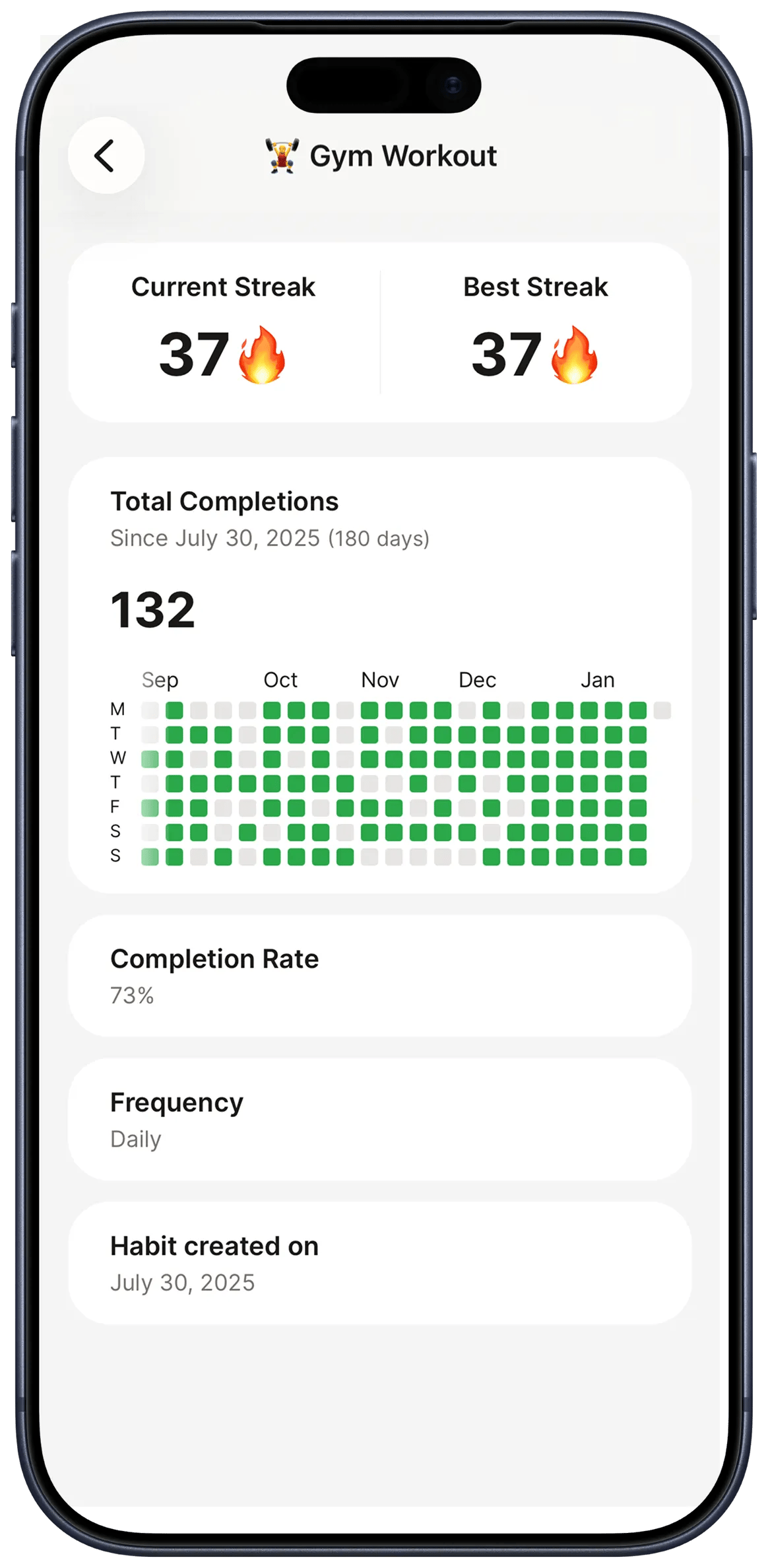
- Track consistency rate alongside streaks. A weekly or monthly completion percentage gives you credit for showing up 6 out of 7 days rather than punishing you for missing one. Both metrics together provide a balanced picture.
- Allow "grace days." Some habit tracking approaches build in planned rest days that don't break the streak. This acknowledges that life happens without triggering the loss aversion spiral.
Streak Length Milestones and Their Psychological Impact
Different streak lengths trigger different psychological effects. Understanding these phases helps you set realistic expectations.
| Days | Phase | What Happens |
|---|---|---|
| 1-7 | Launch | Novelty and excitement carry you. The streak is fragile but the commitment feels fresh. |
| 8-21 | Resistance | The hardest phase. Novelty fades, automaticity hasn't set in. Loss aversion starts doing the work. |
| 22-30 | Traction | The habit feels more natural. You start identifying with it. Social proof kicks in if you've shared your progress. |
| 31-66 | Consolidation | The behavior moves toward automaticity. Lally's research shows this is when most habits lock in. |
| 67-100 | Ownership | The habit is mostly automatic. The streak becomes a source of pride and identity. |
| 100+ | Legacy | The streak itself is part of your identity. The risk shifts from quitting to rigidity -- make sure the habit still serves you. |
The 8-21 day window is where most people fall off. This is exactly the period where understanding common tracking mistakes matters most. If you can push through the resistance phase, the psychological forces working in your favor multiply.
66 days
average time for a new behavior to become automatic
See your streak milestones come to life
Download FreeFrequently Asked Questions
Why are streaks so addictive?▼
Streaks tap into multiple psychological mechanisms simultaneously: loss aversion makes you fear breaking them, dopamine rewards you for extending them, the endowment effect makes you value them more the longer they last, and identity reinforcement makes them feel personally meaningful. This combination creates a strong motivational pull that few other tracking methods can match.
Is it bad to break a habit streak?▼
No. Research from Phillippa Lally at University College London found that missing a single day has no measurable effect on long-term habit formation. The real risk is the 'what-the-hell effect' -- letting one missed day become a full abandonment. Follow the 'never miss twice' rule and resume immediately.
How long should I maintain a streak before the habit is formed?▼
The average is 66 days, according to Lally's research, but it ranges from 18 to 254 days depending on the complexity of the behavior. Simple habits like drinking water form faster than complex ones like exercise routines. Use 66 days as a reasonable target, not a fixed deadline.
Do streaks work better than other habit tracking methods?▼
Streaks work best for daily, binary habits where consistency matters. For habits you only do a few times per week, a completion percentage or total count may be more effective. Research shows streak incentives outperform even higher-paying stable rewards, but they can also cause anxiety in some people. The best approach often combines streaks with a weekly consistency metric.
What should I do when my streak breaks?▼
First, recognize that the habit itself is intact -- only the counter reset. Then restart immediately. Research from the University of Pennsylvania's Behavior Change for Good Initiative found that people who committed to resuming within 24 hours were significantly more likely to maintain long-term consistency. Reframe the break as a data point, not a failure.
- 1.Hot streaks boost productivity, study showsualberta.ca
- 2.Loss aversion - Wikipediaen.wikipedia.org
- 3.The Power of Small Winshbr.org
- 4.landmark 2006 studyresearchgate.net
- 5.Research by Kivetz, Urminsky, and Zhenghome.uchicago.edu
- 6.Why Keeping a Streak Boosts Your Motivationscientificamerican.com
- 7.Phillippa Lally's researchonlinelibrary.wiley.com