 By Adrien Blanc
30-Day Habit Challenge: Build One Life-Changing Habit
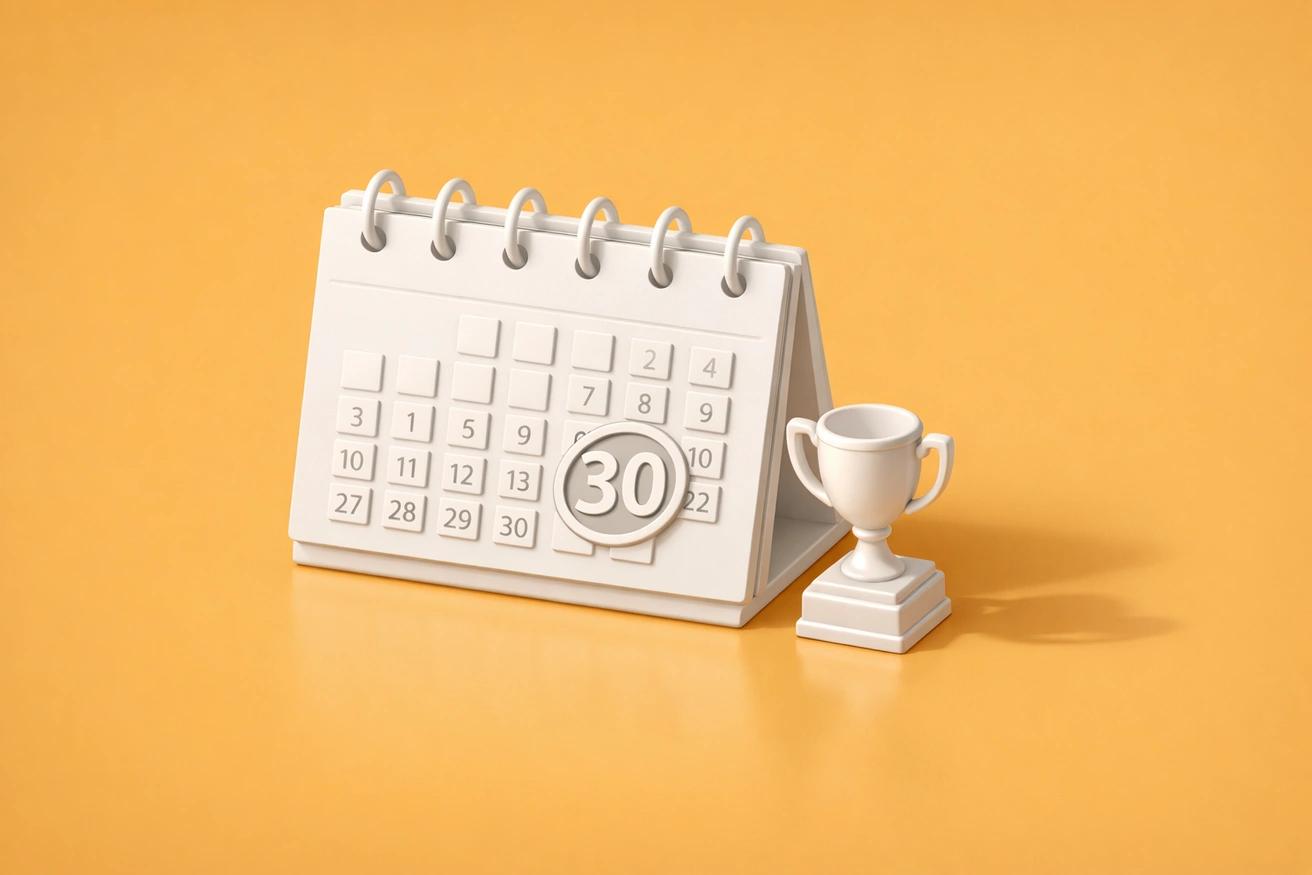
A 30-day habit challenge is one of the most effective ways to kickstart lasting behavior change -- if you do it right. The structure is simple: pick one habit, commit to it every day for 30 days, and track your progress. The reason it works is equally straightforward. Research shows that people who focus on changing one thing at a time are 80% more successful than those who try to change multiple behaviors simultaneously. Try to change three things at once, and your success rate drops to just 5%.
Thirty days won't fully automate a habit -- a 2024 systematic review of 20 studies found that health habits typically take 2 to 5 months to become truly automatic. But a month is enough to build momentum, prove to yourself that the behavior is doable, and establish the daily pattern that makes long-term consistency possible. Think of this challenge not as a finish line, but as a launchpad.
This guide gives you a day-by-day breakdown, the science behind why the hardest days happen when they do, and practical strategies to make it through all 30 days with your habit intact.
80%
higher success rate when focusing on one habit at a time vs. multiple
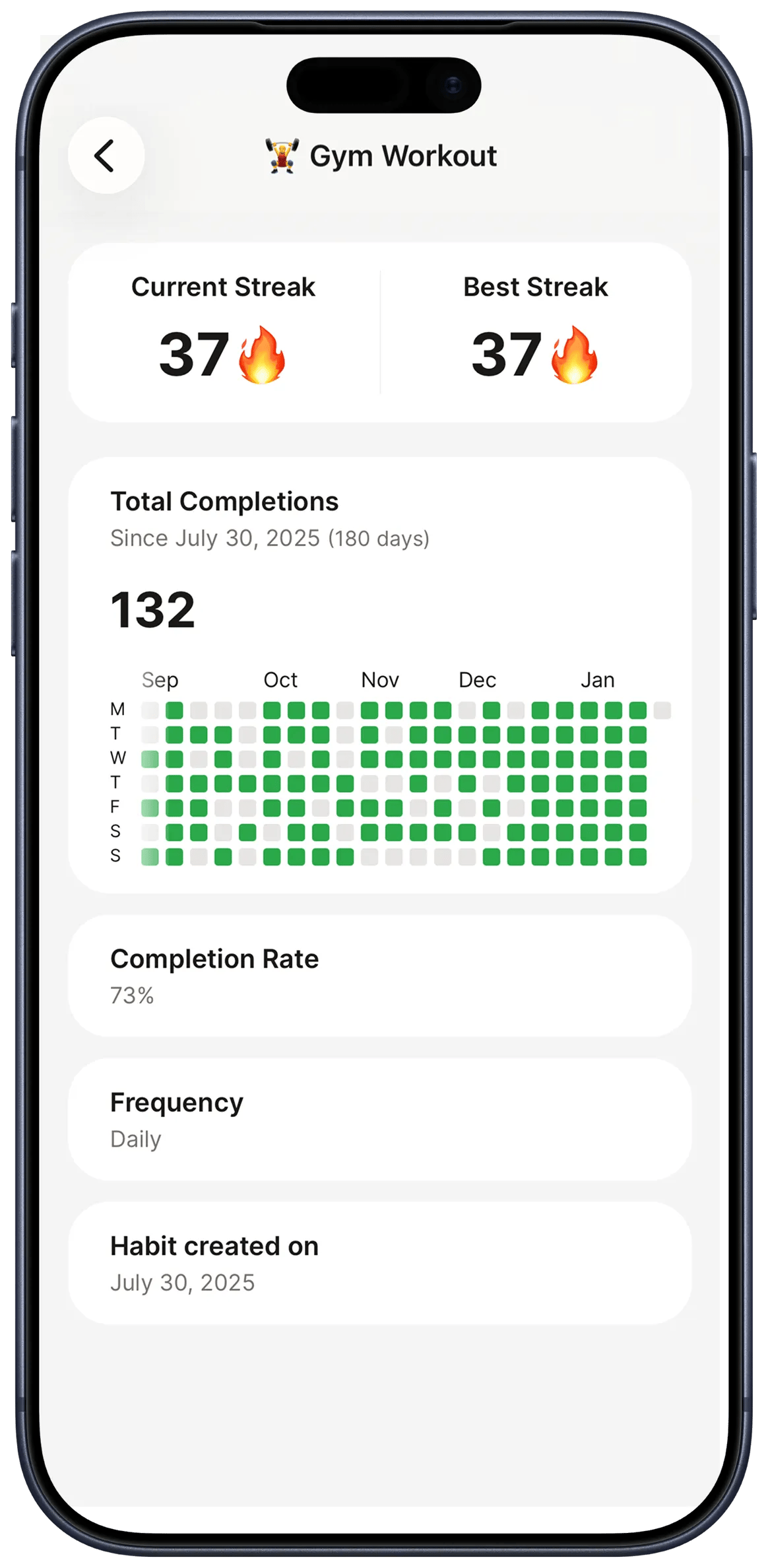
Track your 30-day challenge with daily streaks
Download Free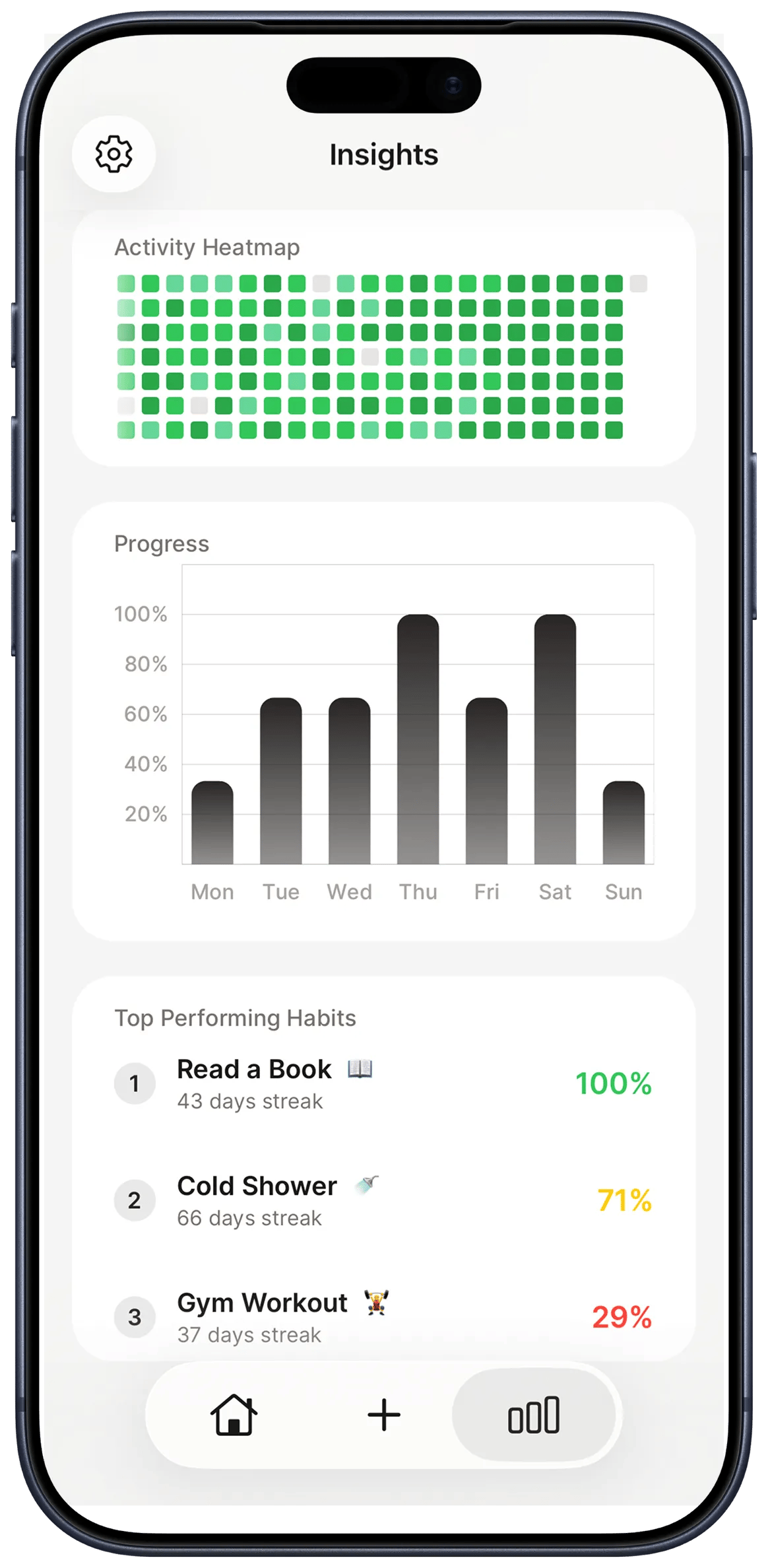
Why 30 Days Is the Perfect Starting Point
Thirty days strikes the ideal balance between commitment and approachability. It's long enough to move past the initial novelty phase and short enough that the end feels reachable on Day 1.
A landmark study by Phillippa Lally at University College London found that the average time to form a habit is 66 days, with a range of 18 to 254 days depending on the person and behavior. That means 30 days gets you roughly halfway to automaticity for many behaviors -- and well past the point where the habit starts feeling natural rather than forced.
There's also a psychological advantage to the bounded timeframe. When people face open-ended commitments like "I'll exercise every day from now on," the weight of forever creates resistance. A 30-day window is different. You can tolerate almost anything for a month. That lower psychological barrier means you're more likely to actually start -- and starting is the hardest part.
The data backs this up. Research from Columbia University shows that only about 25% of people stay committed to New Year's resolutions after 30 days. But people who frame the same goals as structured 30-day challenges -- with daily tracking and clear rules -- show significantly better follow-through because the structure removes ambiguity.
How to Choose Your Challenge Habit
Pick one behavior that is specific, daily, and small enough to do even on your worst day. This single decision determines whether your challenge succeeds or fails.
The biggest mistake people make is choosing something too ambitious. "Get fit" isn't a habit. "Do 10 push-ups after brushing my teeth" is. Research on implementation intentions shows that people who define exactly when and where they'll perform a behavior have a 91% follow-through rate, compared to 35% for those with vague intentions.
Three rules for choosing your habit:
- It should take less than 10 minutes. If it takes longer, you'll skip it on busy days. You can always scale up after the 30 days.
- Attach it to an existing routine. "After I pour my morning coffee, I'll journal for 5 minutes" uses habit stacking -- anchoring a new behavior to an established one -- which research shows increases success rates significantly.
- Choose something you genuinely want, not something you think you should do. Intrinsic motivation outlasts obligation every time.
If you're not sure where to start, our guide on how many habits to track at once explains why starting with one is almost always better than starting with five.
Day-by-Day Breakdown
Each week of a 30-day challenge has a distinct psychological character. Knowing what to expect at each stage helps you prepare for the specific challenges ahead.
Week 1: Building the Foundation (Days 1-7)
The first week runs on excitement and novelty. Motivation is high, and the habit feels fresh. This is the easiest stretch -- which is exactly why you should use it strategically.
- Days 1-3: Set up your tracking system. Whether you use an app, a paper tracker, or a simple calendar, get the visual feedback loop running from Day 1. Tracking your progress is one of the most reliable behavior change techniques in psychology.
- Days 4-7: Refine the details. Adjust the time of day, the trigger, or the duration. The goal is to find a version of the habit that fits your real schedule, not your ideal one.
Key focus: Don't overdo it. The temptation in Week 1 is to do more than planned -- meditate for 20 minutes instead of 5, run 3 miles instead of 1. Resist this. Consistency matters more than intensity, and burning out in Week 1 means there is no Week 2.
Week 2: Pushing Through Resistance (Days 8-14)
Week 2 is where most challenges die. The novelty has worn off, the habit isn't automatic yet, and you're stuck in the uncomfortable middle. Research confirms this -- studies on New Year's resolutions show that 23% of people quit within the first week, and the second Friday of January is nicknamed "Quitter's Day" for a reason.
- Days 8-10: Expect the first real urge to skip. When it hits, scale down rather than skip entirely. A 2-minute version of your habit still counts.
- Days 11-14: Your streak becomes your ally. The psychology of streaks is rooted in loss aversion -- once you've built a 10-day chain, breaking it feels costly, and that feeling works in your favor.
Key focus: Lower the bar, not the frequency. On days when everything conspires against you, do the bare minimum version. The goal is to not break the chain.
Week 3: Finding Your Rhythm (Days 15-21)
Around the midpoint, something shifts. The habit starts feeling less like an obligation and more like a routine. You may notice you do it without much deliberation -- that's the early stages of automaticity forming.
- Days 15-18: This is where the habit begins to feel "normal." You might forget to give yourself credit for doing it, which is actually a good sign.
- Days 19-21: A second danger zone can appear here -- complacency. You feel confident enough to skip "just this once." Remember Lally's research: missing one day doesn't derail formation, but missing multiple days in a row does.
Key focus: Stay consistent but allow yourself grace. Follow the "never miss twice" rule. One off day is a blip. Two in a row is the start of a new pattern.
Week 4: Cementing the Habit (Days 22-30)
The final stretch is about proving to yourself that this behavior is part of who you are. By now, the habit should require noticeably less willpower than it did on Day 1.
- Days 22-25: Start thinking about what comes after Day 30. Will you continue as-is, increase the difficulty, or add a second habit? Planning the transition now prevents the post-challenge dropout.
- Days 26-30: Celebrate the consistency, not perfection. If you completed 26 out of 30 days, you've built a strong foundation. That's an 87% completion rate -- far better than the 9% of Americans who keep resolutions through the year.
Key focus: Transition planning. The biggest risk isn't failing during the challenge -- it's stopping after it ends.
How to Track Your 30-Day Challenge
Daily tracking is what separates a casual attempt from a structured challenge. Without a record, you're relying on memory and motivation -- both of which are unreliable.
The Harkin et al. meta-analysis of 138 studies found that people who physically record their progress are significantly more likely to reach their goals than those who only mentally note it. The act of checking a box or marking a calendar creates a small dopamine reward that reinforces the behavior.
What to track:
- Completion (yes/no). Did you do the habit today? Keep it binary. Avoid tracking "quality" during the challenge -- it invites perfectionism.
- Time of day. Note when you did it. Patterns will emerge that help you optimize your schedule.
- Difficulty rating (optional). A quick 1-5 rating helps you see the habit getting easier over time, which is motivating.
For a deeper look at tracking methods and which one fits your style, see our complete guide to habit tracking.
What to Do After the 30 Days
Day 31 is the most important day of your challenge. What you do after the challenge determines whether you built a lasting habit or just completed a temporary project.
A 2025 systematic review found that most health habits take 2 to 5 months to reach full automaticity. Your 30-day challenge got you partway there, but stopping now means the neural pathways you've been building will weaken.
Three paths forward:
- Continue the habit as-is. If you're enjoying it at its current level, keep going. No need to change what's working. Aim for another 30 days.
- Increase the challenge. If 10 minutes of reading felt easy by Week 3, bump it to 20. If 10 push-ups are routine, try 15. Gradual progression keeps the behavior engaging.
- Add a second habit. Now that your first habit runs on near-autopilot, you have the bandwidth to introduce another. But keep it to one addition at a time -- the research on single-behavior focus still applies.
What not to do: Don't celebrate by taking a week off. Momentum is fragile in the early months. Even a few days away can require significant effort to restart.
10 Popular 30-Day Challenge Ideas
Not sure what habit to tackle? Here are ten proven options, ranked from easiest to most ambitious.
- Drink 8 glasses of water daily. Simple, health-boosting, and easy to track.
- Write 3 things you're grateful for each morning. Takes 2 minutes and has documented mental health benefits.
- Meditate for 5 minutes. Start short. You can increase duration after the challenge.
- Read for 15 minutes before bed. Replace screen time with a calming alternative.
- Walk for 20 minutes. Low barrier, high reward. No gym required.
- No social media before noon. Reclaim your mornings from the scroll.
- Journal for 10 minutes. Reflection builds self-awareness and reduces stress.
- Do a bodyweight workout. Push-ups, squats, planks -- pick 3 exercises and do them daily.
- Learn something new for 15 minutes. A language, an instrument, a coding tutorial.
- Cook one meal from scratch. Builds a useful skill and improves diet simultaneously.
Pick the one that excites you most -- not the one you think you "should" do. Enthusiasm is fuel for the first two weeks, and you'll need it.
For more guidance on choosing your first habit, check out our habit tracker for beginners guide.
Start your 30-day habit challenge today
Download FreeFrequently Asked Questions
Can you really build a habit in 30 days?▼
You can build strong momentum in 30 days, but full automaticity typically takes longer. Research from University College London found the average is 66 days, with a range of 18 to 254 days. A 30-day challenge is a proven launchpad -- not the finish line.
What is the best habit for a 30-day challenge?▼
The best habit is one that is specific, takes less than 10 minutes, and matters to you personally. Popular choices include daily meditation, journaling, walking, reading, and drinking more water. The key is choosing something small enough to do even on your hardest days.
What happens if I miss a day during the challenge?▼
One missed day won't ruin your progress. Phillippa Lally's research at UCL found that missing a single day had no significant impact on habit formation. The danger is missing two or more days in a row. Follow the 'never miss twice' rule and get back on track immediately.
Should I track more than one habit during a 30-day challenge?▼
For your first challenge, stick to one habit. Research shows that focusing on a single behavior change yields an 80% success rate, while attempting three simultaneous changes drops success to just 5%. You can always add more habits after the initial 30 days.
What should I do after the 30 days are over?▼
Keep going. Thirty days gets you partway to automaticity, but stopping can reverse your progress. Either continue the same habit, gradually increase its difficulty, or maintain it while adding one new habit. The goal is to make the behavior permanent, not temporary.
- 1.Transform Your Life in 30 Days: The Science-Backed Guide to Building Habits That Actually Sticktheonlinegp.com
- 2.Time to Form a Habit: A Systematic Review and Meta-Analysis of Health Behaviour Habit Formation and Its Determinantspmc.ncbi.nlm.nih.gov
- 3.landmark study by Phillippa Lally at University College Londononlinelibrary.wiley.com
- 4.New Yearcbsnews.com
- 5.implementation intentionsbpspsychub.onlinelibrary.wiley.com
- 6.How to Build New Habits by Taking Advantage of Old Onesjamesclear.com
- 7.New Year's resolutions: Why do we give up on them so quickly?bcm.edu
- 8.New Year's Resolutions Statistics and Trendsdriveresearch.com
- 9.Does monitoring goal progress promote goal attainment? A meta-analysis of the experimental evidencepubmed.ncbi.nlm.nih.gov
- 10.How Gratitude Changes You and Your Braingreatergood.berkeley.edu