 By Adrien Blanc
Does Habit Tracking Actually Work? What the Science Says
Yes, habit tracking works -- and the evidence is strong. A meta-analysis of 138 studies published in Psychological Bulletin found that people who regularly monitor their progress toward goals are significantly more likely to achieve them than those who don't. The study, led by Benjamin Harkin at the University of Sheffield, analyzed data from nearly 20,000 participants and concluded that self-monitoring -- the core mechanism behind habit tracking -- is one of the most reliable behavior change techniques available.
That finding isn't isolated. A Kaiser Permanente study of nearly 1,700 participants found that those who kept a daily food diary lost twice as much weight as those who kept no records. And a study published in the British Journal of Health Psychology showed that participants who wrote down exactly when and where they intended to exercise were far more likely to follow through: 91% exercised at least once per week, compared to just 35-38% in the control groups.
The short answer: tracking doesn't just feel productive -- it measurably changes behavior. But the details matter. Here's what the research actually shows about when tracking helps, when it doesn't, and how to do it right.
2x
more weight lost by people who kept daily food diaries vs. those who didn't
Start building habits backed by science
Download Free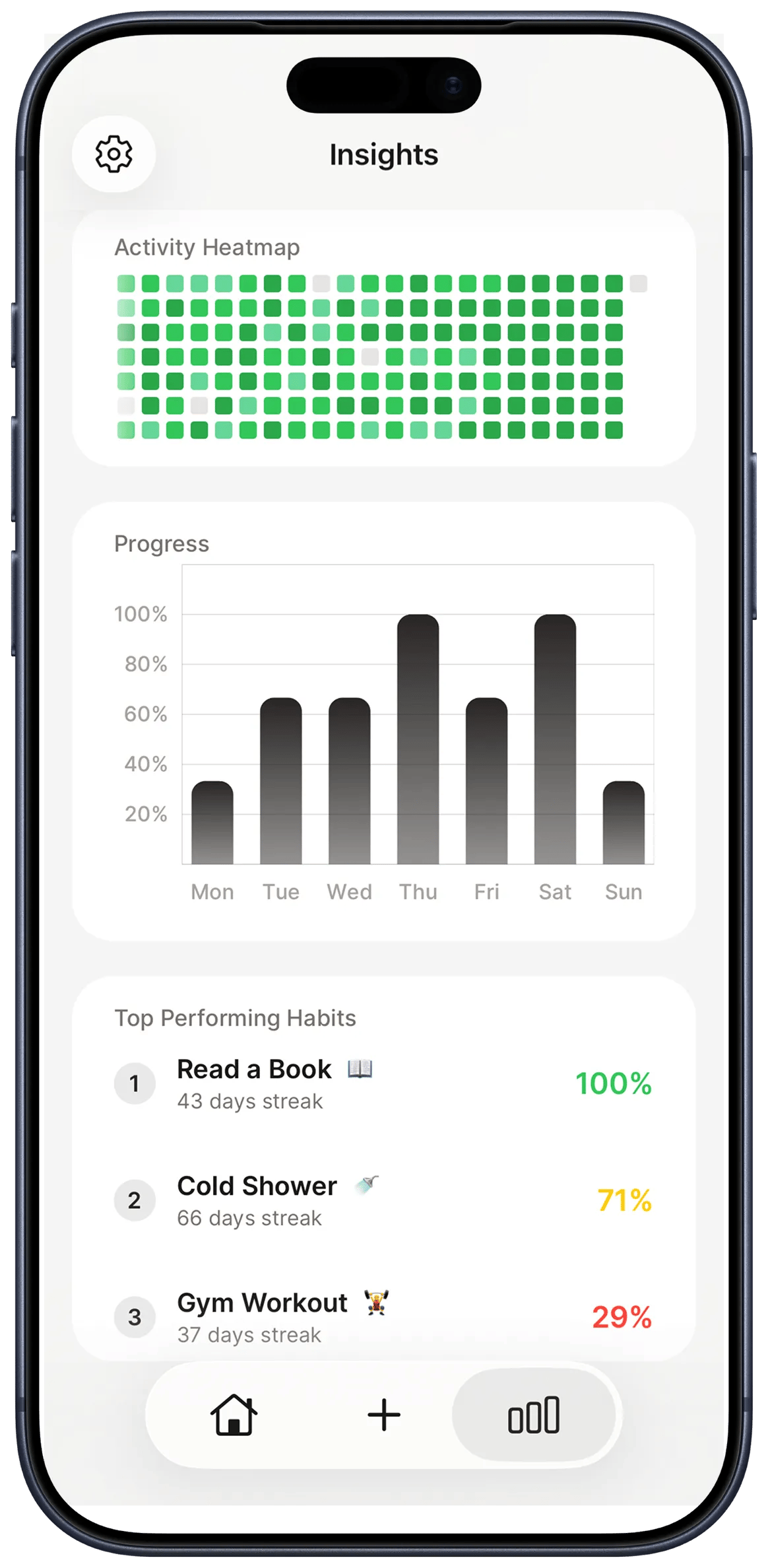
How Self-Monitoring Changes Behavior
Self-monitoring works because it closes the gap between what you intend to do and what you actually do. Most people overestimate their consistency and underestimate their lapses. Tracking forces an honest reckoning.
The psychological mechanism is well-documented. When you observe and record your own behavior, you create a feedback loop that researchers call reactivity -- the act of measuring a behavior changes that behavior. This isn't a side effect; it's the whole point.
Here's what happens when you track a habit:
- Awareness increases. You notice patterns you'd otherwise miss -- which days you skip, what triggers success, what causes failure.
- Cognitive load drops. Instead of keeping mental tabs on six different goals, you offload the tracking to an external system. Your brain can focus on doing rather than remembering.
- Rewards become immediate. Marking a habit complete triggers a small dopamine response. Over time, this turns the tracking itself into part of the habit loop: cue, behavior, checkmark, satisfaction.
- Identity shifts. Each recorded day becomes a "vote" for the person you want to be. A week of checkmarks says, "I am someone who exercises." That narrative becomes self-reinforcing.
The Harkin et al. meta-analysis also found that monitoring was most effective when it was done frequently and when results were physically recorded rather than just mentally noted. Writing it down -- whether on paper or in an app -- matters more than simply thinking about your progress.
What the Key Studies Show
The research on self-monitoring spans decades and thousands of participants. Here are the most relevant findings.
The Harkin Meta-Analysis (2016)
Benjamin Harkin and colleagues at the University of Sheffield analyzed 138 experimental studies with a combined 19,951 participants. They found that interventions prompting people to monitor their goal progress produced a medium effect size (d = 0.40) on goal attainment. The more frequently people monitored, the better their outcomes. This study is the strongest evidence we have that tracking works across different types of goals -- weight loss, exercise, smoking cessation, and more.
The Kaiser Permanente Food Diary Study (2008)
In one of the largest weight-loss maintenance trials ever conducted, researchers found that the single best predictor of weight loss was how often participants kept food diaries. Those who logged their meals daily lost an average of twice as much weight as non-trackers. Lead author Jack Hollis, Ph.D., noted: "It seems that the simple act of writing down what you eat encourages people to consume fewer calories."
The Lally Habit Formation Study (2009)
Phillippa Lally's study at University College London tracked 96 participants building new habits over 12 weeks. The average time to reach automaticity was 66 days, with a range of 18 to 254 days. Critically, she found that missing a single day did not derail the habit formation process -- consistency matters more than perfection.
The Implementation Intentions Study (2002)
Milne, Orbell, and Sheeran's study in the British Journal of Health Psychology demonstrated the power of writing down specific plans. Participants who wrote when and where they'd exercise had a 91% follow-through rate, compared to 35-38% in the motivation-only and control groups. This study specifically highlights why tracking that includes planning -- not just recording -- produces the best results.
The Psychology of Streaks and Consistency
Streaks add a motivational layer on top of basic tracking. When you've logged seven consecutive days of a habit, breaking that streak feels costly -- and that's by design.
This effect is rooted in loss aversion, a well-established principle from behavioral economics. Daniel Kahneman and Amos Tversky's research showed that people feel losses roughly twice as strongly as equivalent gains. A 30-day streak isn't just 30 checkmarks -- it's something you've built that you don't want to lose.
Teresa Amabile's research at Harvard Business School adds another dimension. Her analysis of nearly 12,000 diary entries found that making progress -- even small progress -- was the single strongest contributor to positive inner work life, outweighing recognition, incentives, and interpersonal support. Each day you complete a tracked habit is a small win that fuels the next one.
The combination of loss aversion and the progress principle explains why streaks are so psychologically powerful. But it also creates a risk: when people become too attached to their streak, they start doing the habit poorly just to preserve the number. That's when tracking stops serving you.
When Habit Tracking Can Be Counterproductive
Tracking is a tool, not a cure-all, and it can backfire in specific situations. Recognizing when tracking hurts is just as important as knowing when it helps.
Over-Tracking and Anxiety
Tracking too many habits at once creates cognitive overload. Instead of simplifying your life, a bloated tracker becomes another source of stress. Research on self-monitoring in health contexts has documented cases where constant measurement fuels anxiety and obsessive behavior, particularly around eating and exercise. If your tracker makes you feel worse, that's a signal to scale back, not push harder.
Perfectionism Traps
All-or-nothing thinking is the biggest threat to long-term tracking. When you view a missed day as a failure rather than a data point, you're more likely to abandon the whole system. This is the "what-the-hell effect" -- one slip becomes an excuse to give up entirely. Lally's research directly counters this: one missed day has no meaningful impact on habit formation.
Tracking the Wrong Things
Some goals don't translate well into daily habits. Complex creative projects, relationship quality, and emotional well-being resist simple yes/no tracking. Forcing them into a tracker can reduce rich experiences to hollow checkboxes. Track behaviors you control, not outcomes you hope for.
When the Streak Becomes the Goal
If you find yourself rushing through a meditation just to tap "done," or walking in circles at 11 PM to hit a step count, the tracker has taken over. The purpose of tracking is behavior change, not a perfect scorecard.
What Makes Habit Tracking Most Effective
The most effective tracking systems share a few research-backed features. Not all approaches work equally well.
Keep It Simple
Start with 3-5 habits, each defined as a clear binary action. "Meditate" is vague. "Meditate for 5 minutes after my morning coffee" is trackable. Research on habit formation apps by Dr. Katarzyna Stawarz found that apps supporting contextual cues and implementation intentions produced better outcomes than those relying on willpower alone.
Track Frequently
The Harkin meta-analysis found that more frequent monitoring produced better results. Daily tracking outperforms weekly check-ins. If daily feels like too much, try tracking your most important habit daily and the rest weekly.
Combine Tracking With Other Strategies
A meta-review synthesizing data from over 400,000 participants found that self-monitoring works best when combined with other behavior change techniques -- particularly goal setting, implementation intentions, and social accountability. Tracking alone moves the needle; tracking plus a plan moves it further.
Use Visual Feedback
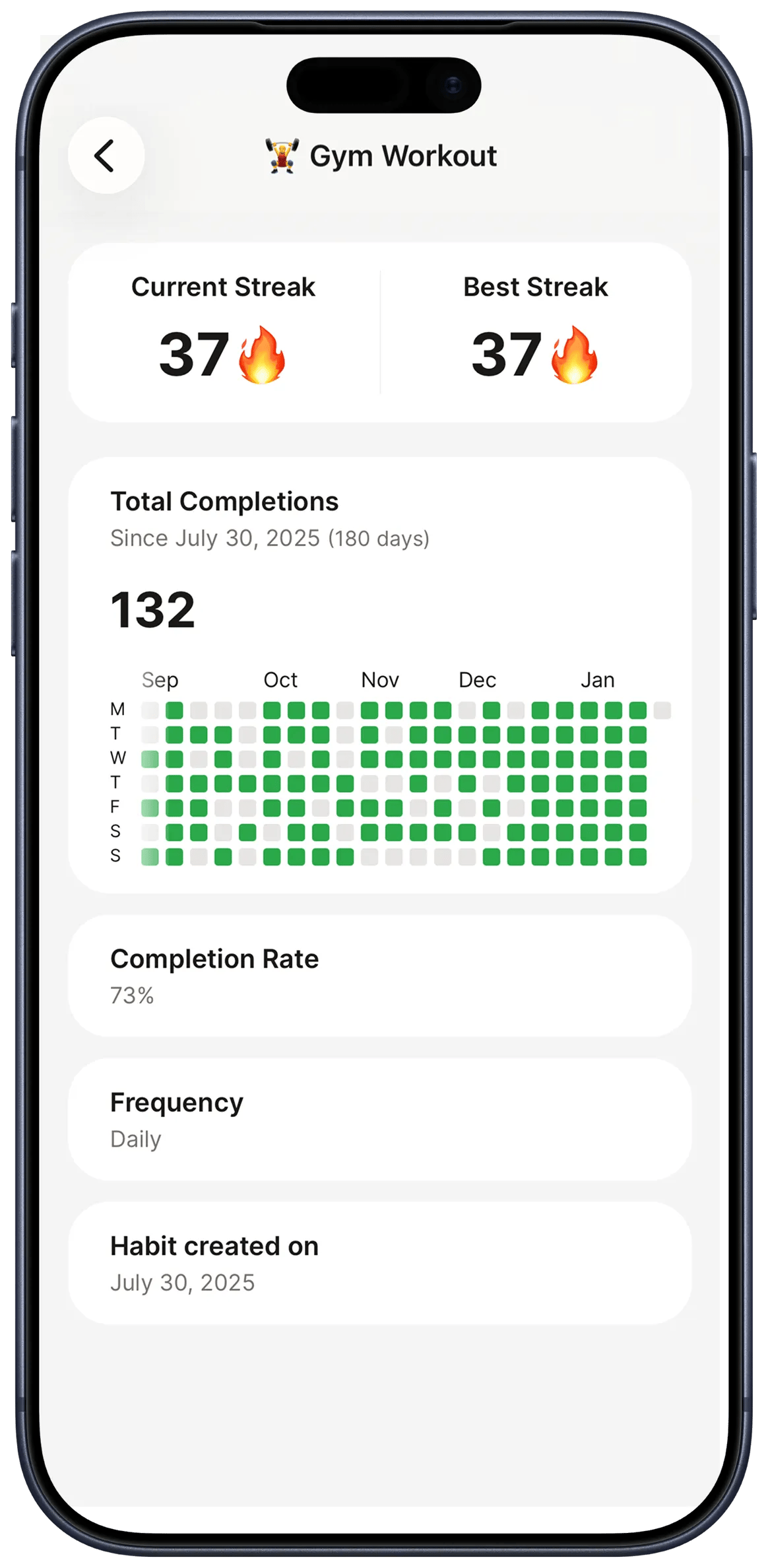
Whether it's a streak counter, a heatmap, or a row of colored squares, visual progress feeds motivation. Amabile's progress principle applies directly: seeing your accumulating effort reinforces the identity you're building.
Build in Flexibility
The "never miss twice" rule is more effective than demanding perfection. Allow yourself grace days. Track your batting average over a month rather than obsessing over any single day. For a deeper look at common habit tracking mistakes, we've covered the pitfalls to avoid.
How to Start Tracking Habits That Stick
Getting started is simpler than most people think. The biggest risk isn't choosing the wrong tool -- it's overthinking the setup and never beginning.
Here's a research-informed approach:
- Pick 3 habits. Choose behaviors that are specific, daily, and meaningful to you. One health habit, one productivity habit, and one personal growth habit is a balanced starting point.
- Define your cues. For each habit, write an implementation intention: "After [existing routine], I will [new habit]." This format alone can more than double your follow-through rate.
- Choose one tracking method. App, paper, or spreadsheet -- pick one and commit for two weeks. Don't split your habits across multiple systems.
- Set a daily review. Spend 60 seconds each evening checking off completed habits. This review moment is itself a habit worth building.
- Review weekly. Every week, look at your completion rates. Adjust habits that are too hard (make them smaller) or too easy (make them slightly more challenging).
For a full walkthrough, see our complete guide to habit tracking, which covers setup, tool selection, and long-term strategies in detail.
91%
exercise follow-through rate when participants wrote specific when/where plans
The Bottom Line
Habit tracking works -- and the evidence isn't even close. Self-monitoring is one of the most replicated findings in behavioral science. People who track their habits are more consistent, more self-aware, and more likely to reach their goals than those who rely on memory and motivation.
But tracking is a tool, not magic. It works best when you keep it simple, track frequently, combine it with clear plans, and give yourself permission to be imperfect. The goal isn't a flawless record. It's a system that keeps you moving in the right direction, even when motivation fades.
Start small. Track honestly. Review regularly. The research says that's enough.
Track your habits and see the science in action
Download FreeFrequently Asked Questions
Is there scientific evidence that habit tracking works?▼
Yes. A meta-analysis of 138 studies published in Psychological Bulletin found that monitoring goal progress significantly increases the likelihood of achieving those goals. Additional studies on food diaries, exercise, and health behaviors consistently confirm the effectiveness of self-monitoring.
How long do I need to track a habit before it becomes automatic?▼
Research from University College London found that the average time to form a habit is 66 days, with a range of 18 to 254 days. The timeline depends on the complexity of the behavior and how consistently you perform it.
Can habit tracking be harmful?▼
In some cases, yes. Over-tracking can fuel anxiety and perfectionism, particularly around eating and exercise. If tracking becomes a source of stress, scale back to fewer habits or take a break. The goal is behavior change, not a perfect scorecard.
What is the best way to track habits?▼
The best method is the one you'll actually use consistently. Mobile apps offer reminders and visual streaks, paper journals provide a tactile experience, and spreadsheets give full customization. Research shows that frequent, recorded tracking works better than mental self-monitoring.
Does missing a day ruin my habit progress?▼
No. Research from Phillippa Lally at UCL found that missing a single day did not materially affect the habit formation process. What matters is your overall consistency, not a perfect streak. Follow the 'never miss twice' rule and get back on track the next day.
- 1.Does monitoring goal progress promote goal attainment? A meta-analysis of the experimental evidencepubmed.ncbi.nlm.nih.gov
- 2.Keeping A Food Diary Doubles Diet Weight Loss, Study Suggestssciencedaily.com
- 3.study published in the British Journal of Health Psychologybpspsychub.onlinelibrary.wiley.com
- 4.analyzed 138 experimental studiesapa.org
- 5.Phillippa Lally's study at University College Londononlinelibrary.wiley.com
- 6.The Power of Small Winshbr.org
- 7.Habit trackers: does tracking your habits actually work?nesslabs.com
- 8.Dr. Katarzyna Stawarzresearchgate.net
- 9.Self-regulatory behavior change techniques in interventions to promote healthy eating, physical activity, or weight l...pmc.ncbi.nlm.nih.gov