 By Adrien Blanc
9 Daily Habits to Build Genuine Self-Confidence

Self-confidence is not a fixed personality trait you either have or lack. It is a skill built through repeated daily actions. Research in psychology consistently shows that confidence follows a virtuous cycle: when you believe in yourself, you take on challenges, succeed more often, and reinforce that belief further. The reverse is also true — low confidence leads to avoidance and fewer opportunities to prove yourself capable.
According to Dr. Joe Rubino, roughly 85% of people worldwide struggle with low self-esteem, and imposter syndrome affects an estimated 70% of successful professionals at some point in their careers. These are staggering numbers, but they also highlight an opportunity. Because confidence is behavioral, not genetic, the right daily habits can meaningfully shift how you see yourself.
The nine habits below are grounded in behavioral science and practical enough to start today. Each one builds a slightly different dimension of confidence — from physical presence to inner dialogue to social connection. Stacked together over weeks and months, they form the foundation of healthy habit-building that rewires how you experience yourself.
Track your daily confidence habits and build streaks that stick.
Download Free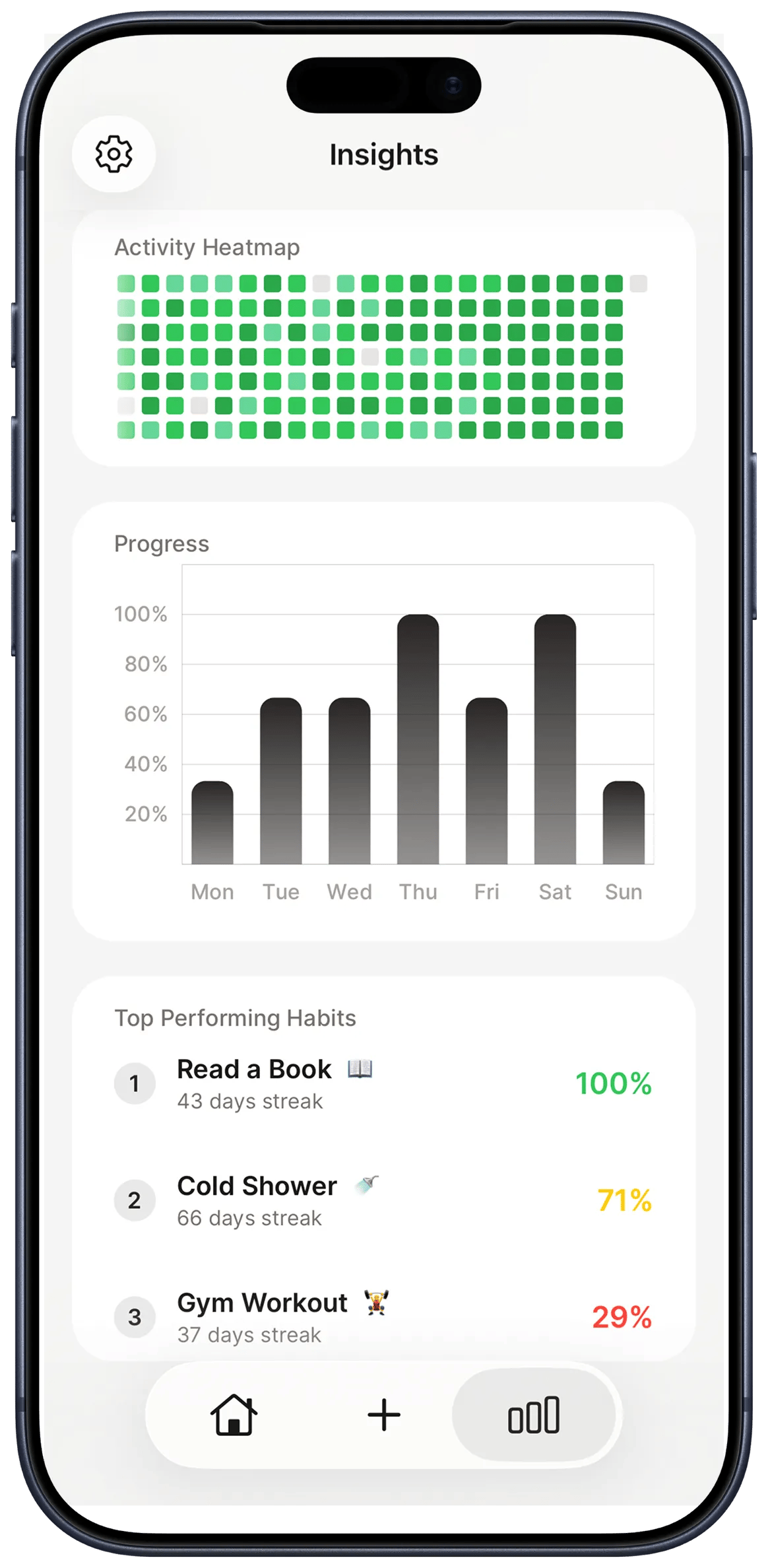
Confidence Is Built, Not Born
Self-confidence is the product of consistent action, not innate talent. Cognitive science describes it as a feedback loop: action produces evidence, evidence shapes belief, and belief drives further action. A review published in PMC found that high self-esteem is associated with better health outcomes, stronger social lives, healthier coping mechanisms, and protection against mental disorders.
The key insight is that you do not wait until you feel confident to act. You act first, and the feeling follows. This is why habit-based approaches work so well — they remove the need for motivation and replace it with structure. If you are new to building routines, a habit stacking approach can help you anchor these confidence practices to things you already do.
Keep Promises to Yourself
Every time you set a small intention and follow through, you deposit trust into your own self-image. Every time you break a promise to yourself — skipping the workout, ignoring the alarm — you erode it. Self-trust is the bedrock of confidence.
This is why the size of the promise matters less than the consistency. Commit to something manageable:
- Write for 10 minutes before checking your phone
- Do five push-ups right after waking up
- Read one page before bed
When you keep these micro-commitments daily, you train your brain to see yourself as someone who follows through. Research on tiny habits shows that starting with minimal viable actions — then scaling up gradually — makes people 2.7 times more likely to maintain long-term habits than those who start with ambitious targets.
Physical Exercise and Confidence
Few habits have as much research backing their connection to self-esteem as regular physical movement. A meta-analysis in PLOS ONE across 25 randomized controlled trials found a significant positive effect of physical activity on self-concept (Hedges' g = 0.49, p = 0.014). A study of over 700 young adults found that regular exercisers had statistically higher self-efficacy, self-esteem, and body awareness than sedentary individuals (P < 0.001).
You do not need to run marathons. The research shows benefits from moderate, consistent activity. A brisk 20-minute walk, a short bodyweight routine, or a yoga session all count. The confidence boost comes from two pathways: the physiological release of endorphins and the psychological proof that you showed up for yourself.
If you are starting from scratch, an exercise habit for beginners guide can help you build consistency without burnout.
0.49
effect size of exercise on self-concept in meta-analysis
Practice Positive Self-Talk
The conversation inside your head shapes your confidence more than almost any external factor. Self-affirmation has measurable effects on brain activity, performance, and self-esteem — but it works differently than most people assume.
Research published in Social Cognitive and Affective Neuroscience found that self-affirmation activates the brain's self-processing and reward systems (medial prefrontal cortex and ventral striatum). The APA reported in 2025 that self-affirmations can measurably boost well-being. And a cross-lagged study found a correlation of 0.46 between spontaneous self-affirmation and trait self-esteem.
But there is a nuance. Telling yourself "I am amazing" when you do not believe it can backfire for people with already-low self-esteem. More effective self-talk is evidence-based and specific:
- Instead of "I'm confident," try "I handled that meeting well because I prepared."
- Instead of "I'm great at everything," try "I've improved at this skill over the past month."
- Reframe mistakes: "That didn't go as planned, but I learned something specific."
This evidence-based approach keeps affirmations grounded in reality, which makes them more believable and more effective.
Set and Achieve Small Daily Goals
Confidence grows from accumulated evidence of competence. The fastest way to generate that evidence is to set small, specific goals each day and complete them. This creates what psychologists call mastery experiences — the strongest source of self-efficacy according to Albert Bandura's research.
A practical approach:
- Each morning, write down 1-3 small goals for the day (not your full to-do list)
- Make them specific and achievable: "Draft the introduction of my report" rather than "Work on report"
- Check them off visibly — the visual record matters
The accumulation of small wins rewires your default expectation from "I probably can't" to "I've done things like this before." Over time, this shifts your entire baseline of self-belief. Tracking these completions with a daily routine that actually works helps create the structure that makes consistency easier.
Step Outside Your Comfort Zone
Growth and comfort rarely coexist. Research by Woolley and Fishbach at Cornell found that actively seeking discomfort increased participants' persistence, risk-taking, and learning. In a separate study, 70% of "comfort zone breakers" reported feelings of courage after pushing past their boundaries.
The goal is not to terrify yourself daily. It is to practice manageable discomfort:
- Speak up once in a meeting where you would normally stay quiet
- Start a conversation with someone new
- Try a skill you have been avoiding because you might be bad at it
- Say no to something you would normally agree to out of people-pleasing
Each small act of courage builds evidence that you can handle uncertainty. That evidence is what confidence is made of. The key is gradual progression — pushing just beyond your current edge, not leaping into panic territory.
Dress Intentionally
What you wear affects more than how others perceive you — it shapes how you think and perform. This phenomenon, called enclothed cognition, was identified in a landmark 2012 study by Adam and Galinsky. Participants who wore a lab coat described as a "doctor's coat" showed measurably increased sustained attention compared to those who wore the same coat described as a "painter's coat" or who simply looked at it.
The principle extends beyond lab coats. Research shows that clothing choices reflect and reinforce how we feel about ourselves. Dressing in a way that aligns with the version of yourself you want to be creates a feedback loop between external appearance and internal state.
This does not mean wearing formal clothes every day. It means choosing your outfit with intention rather than defaulting to whatever is closest. Ask yourself: "Does what I'm wearing reflect how I want to show up today?" That small act of intentionality signals to your brain that today matters and that you are worth the effort.
Celebrate Your Wins
Most people have a negativity bias — the brain naturally gives more weight to failures and criticism than to successes. Actively celebrating wins counterbalances this bias and reinforces the neural pathways associated with competence.
Celebration does not have to be dramatic. It can be:
- Writing down three things that went well at the end of each day
- Telling someone about a small accomplishment
- Pausing for 10 seconds after completing a task to acknowledge the effort
- Keeping a "done" list alongside your to-do list
This practice is closely related to gratitude journaling, which research has linked to improved well-being and self-perception. The point is to train your attention toward evidence of your own capability. Over time, this shifts your default self-narrative from "I never do enough" to "I'm making real progress."
Help Others Daily
One of the most counterintuitive confidence builders is shifting your focus outward. Research published in PMC found a positive correlation between prosocial behavior and well-being (r = 0.22, p < 0.01), with basic psychological needs partially mediating this relationship. Volunteers consistently report higher self-esteem, greater life satisfaction, and less depression than non-volunteers.
Helping others builds confidence through three mechanisms:
- It provides evidence of your own competence and usefulness
- It strengthens social connections, which reinforce a sense of belonging
- It shifts attention away from self-critical rumination
You do not need to volunteer at a shelter every day. Small acts count: giving genuine compliments, helping a colleague with a problem, sharing useful information, or mentoring someone newer than you. A study of 104 participants found that committing five random acts of kindness per week over six weeks made people measurably happier than a control group.
Limit Comparison Scrolling
Social media is designed to show you curated highlights of other people's lives. A meta-analysis of social media research found that upward comparison conditions are associated with lower self-esteem, with a pooled effect size of g = -0.24 (Schmuck et al., 2023). The more you passively scroll, the more your brain registers "evidence" that everyone else is doing better than you.
Practical strategies to limit the damage:
- Set specific times for social media rather than checking reflexively
- Unfollow or mute accounts that consistently make you feel inadequate
- Switch from passive to active use — comment, create, and connect rather than just watching
- Replace scrolling time with a habit that builds confidence, like exercise or reading
If you are working on reducing screen time more broadly, a guide on screen time reduction can provide a structured approach. The goal is not to quit social media entirely but to be intentional about when and how you use it, so it stops quietly chipping away at how you see yourself.
Putting It All Together
You do not need to adopt all nine habits at once. Pick two or three that resonate most and practice them consistently for a few weeks before adding more. This aligns with the science of building healthy habits — starting small and building gradually produces far more durable results than trying to overhaul everything overnight.
Confidence is not a destination. It is a byproduct of showing up, keeping your word to yourself, and accumulating evidence that you are capable of more than you think. The habits themselves are simple. The hard part — and the rewarding part — is doing them day after day.
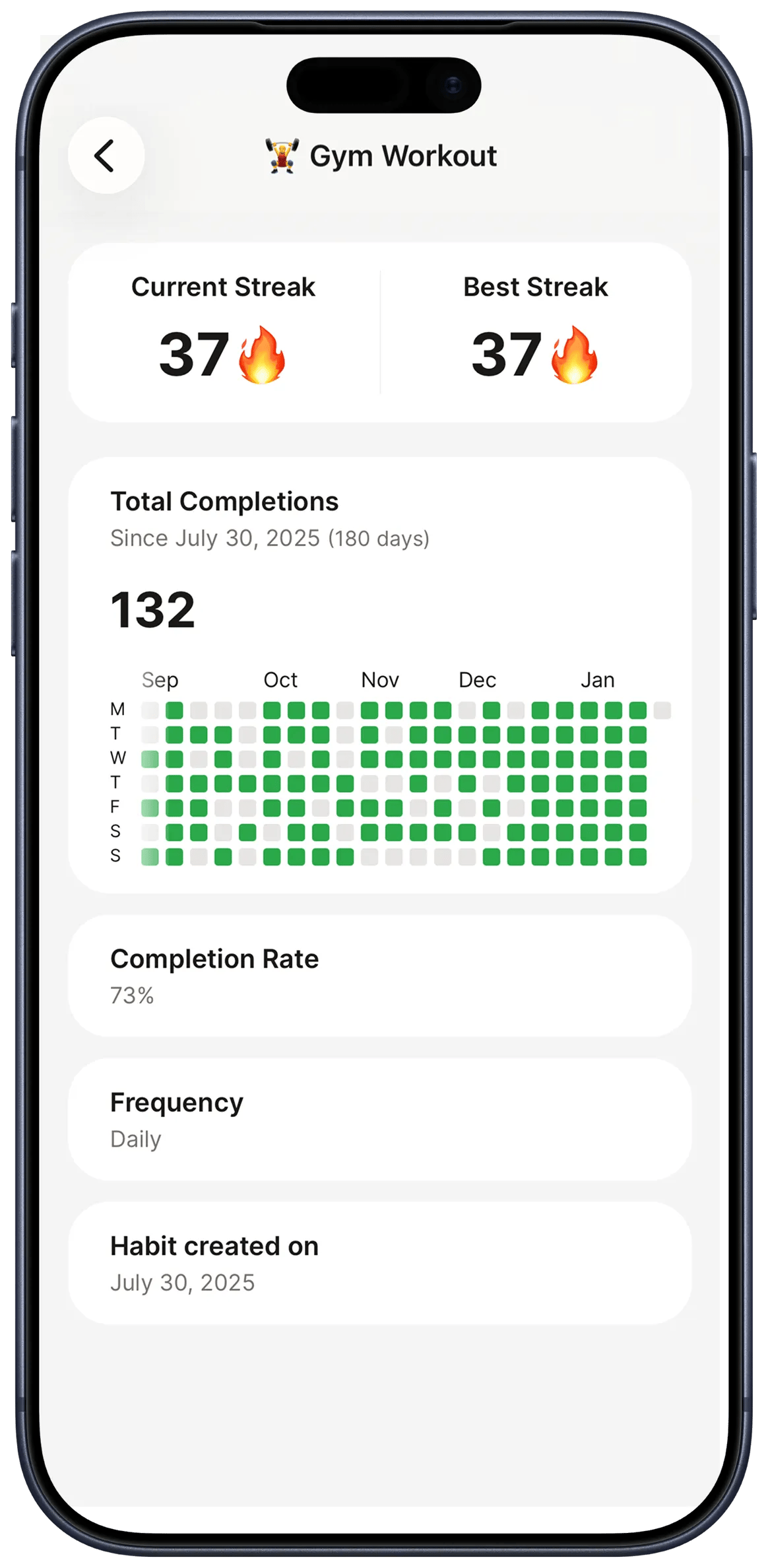
Start building your confidence habits today. Track streaks, set reminders, and watch your progress grow.
Download FreeFrequently Asked Questions
How long does it take to build self-confidence through habits?▼
Research suggests that habit formation takes an average of 66 days, though it varies by person and complexity. You may notice small shifts in self-perception within 2-3 weeks of consistent practice. Genuine, lasting confidence builds over months as you accumulate evidence of your own follow-through and competence.
Can you build confidence if you have low self-esteem?▼
Yes, but the approach matters. People with low self-esteem benefit more from evidence-based self-talk (acknowledging specific things they did well) rather than generic positive affirmations. Starting with very small commitments and building up gradually creates a foundation of self-trust without triggering the inner critic.
What is the single most effective habit for building confidence?▼
Keeping promises to yourself is arguably the most foundational. When you consistently follow through on small commitments — even tiny ones like making your bed or doing five push-ups — you build self-trust, which is the core ingredient of confidence. Physical exercise is a close second due to its combined psychological and physiological benefits.
Does social media really hurt self-confidence?▼
Research consistently shows that passive social media use and upward comparison are associated with lower self-esteem. A meta-analysis found a significant negative effect (g = -0.24) on self-evaluations during upward comparison. However, active use — creating content, connecting with close friends — can have neutral or even positive effects on confidence.
How many confidence habits should I start with?▼
Start with two or three. Trying to adopt all nine at once is a recipe for overwhelm and failure, which would undermine the very confidence you are trying to build. Once your initial habits feel automatic (usually after 4-8 weeks), add one or two more. The goal is sustainable progress, not a perfect overhaul.
- 1.20 Self Esteem Statistics That Will Help You Feel Better (2025)soocial.com
- 2.Is High Self-Esteem Beneficial? Revisiting a Classic Questionpmc.ncbi.nlm.nih.gov
- 3.meta-analysis in PLOS ONEjournals.plos.org
- 4.study of over 700 young adultspubmed.ncbi.nlm.nih.gov
- 5.Self-affirmation activates brain systems associated with self-related processing and reward and is reinforced by futu...pmc.ncbi.nlm.nih.gov
- 6.APA reported in 2025apa.org
- 7.a correlation of 0.46sciencedirect.com
- 8.Leaving your comfort zone inspires motivation, growthnews.cornell.edu
- 9.Don't Let Your Comfort Zone Be a Barrierpsychologytoday.com
- 10.Enclothed cognitionsciencedirect.com
- 11.Styling the Self: Clothing Practices, Personality Traits, and Body Image Among Israeli Womenpmc.ncbi.nlm.nih.gov
- 12.Assessing the Relationship between Prosocial Behavior and Well-Being: Basic Psychological Need as the Mediatorpmc.ncbi.nlm.nih.gov
- 13.Prosocial behavior, psychological well-being, positive and negative affect among young adults: A cross-sectional studypmc.ncbi.nlm.nih.gov
- 14.Happiness and Prosocial Behavior: An Evaluation of the Evidenceworldhappiness.report
- 15.(Schmuck et al., 2023)tandfonline.com